be transiently disrupted, a net movement of charge across the membrane will occur, V., will deflect from its resting value, and a bioelectrical signal will be generated. For any given change in g.. the direction of the resulting change in I, and its magnitude, i.e., the nature of the signal, will be determined by the direction and magnitude of the electrochemical driving force acting on X.
I have found that most students easily grasp the concept and mechanism of changes in membrane conductance. Computing the numerical value of electrochemical driving force is also simple. However, understanding the mechanistic basis of ECDF and, in particular, determining its direction for a particular ion under a given set of conditions are often considerably more difficult. Note that this last determination is critical because for any ion the direction of its electrochemical driving force will determine the direction of its passive flux and therefore,
Sample problem 1. Consider a situation where K ion has an intracellular fluid (ICF) concentration of 350 mM and an extracellular fluid (ECF) concentration of 50 mM. What will be the direction and magnitude of the ECDF acting on K at $V_m = -60 mV$?
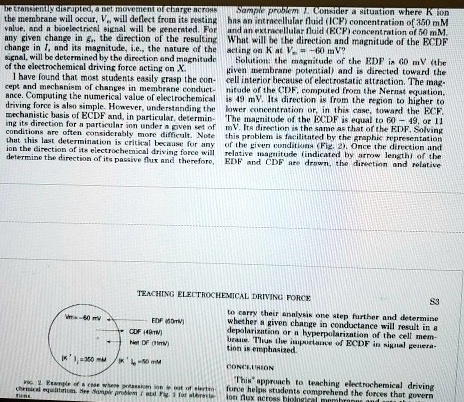
Solution: the magnitude of the EDF is 60 mV (the given membrane potential) and is directed toward the cell interior because of electrostatic attraction. The magnitude of the CDF, computed from the Nernst equation, is 49 mV. Its direction is from the region to higher to lower concentration or, in this case, toward the ECF. The magnitude of the ECDF is equal to 60 - 49, or 11 mV. Its direction is the same as that of the EDF. Solving this problem is facilitated by the graphic representation of the given conditions (Fig. 2). Once the direction and relative magnitude (indicated by arrow length) of the EDF and CDF are drawn, the direction and relative
to carry their analysis one step further and determine whether a given change in conductance will result in a depolarization or a hyperpolarization of the cell membrane. Thus the importance of ECDF in signal generation is emphasized.
CONCLUSION
This approach to teaching electrochemical driving force helps students comprehend the forces that govern ion flux across biological membranes and that driving