Ace - AI Tutor
Ask Our Educators
Textbooks
My Library
Flashcards
Scribe - AI Notes
Notes & Exams
Download App
Deniz Oz

Deniz O.

Divider

Questions asked

INSTANT ANSWER

Q9. The rate of the second-order decomposition of acetaldehyde \( \left(\mathrm{CH}_{3} \mathrm{CHO}\right) \) was measured over the temperature range \( 700-1000 \mathrm{~K} \), and the rate constants are reported below. \begin{tabular}{|l|l|l|l|l|l|l|l|l|} \hline \( \mathbf{T} / \mathbf{K} \) & 700 & 740 & 780 & 800 & 810 & 850 & 950 & 1000 \\ \hline \( \mathbf{k} /\left(\mathbf{d m}^{3} \mathbf{m o l}^{-1} \mathbf{S}^{-1}\right) \) & \( 0.007 \) & \( 0.041 \) & \( 0.209 \) & \( 0.446 \) & \( 0.642 \) & \( 2.540 \) & \( 47.59 \) & \( 165.34 \) \\ \hline \end{tabular} 1. Show the plot. 2. Write down the equation. 3. Find \( \mathrm{E}_{2} \) and \( \mathrm{A} \).

View Answer
divider
INSTANT ANSWER

Q8. The gas-phase reaction of fluorine atoms with bromine is shown below. \[ \mathrm{F}+\mathrm{Br}_{2} \rightarrow \mathrm{FBr}+\mathrm{Br} \] The following concentrations of \( \mathrm{Br}_{2} \) were observed as a function of time at \( 298 \mathrm{~K} \) when the initial fluorine atom concentration was \( [\mathrm{F}]=4 \times 10^{-9} \mathrm{~mol} \mathrm{dm}^{-3} \). \begin{tabular}{|c|c|} \hline Time/s & {\( \left[\mathbf{B r}_{2}\right] / \mathbf{1 0}^{-9} \mathbf{m o l ~ d m}^{-\mathbf{3}} \)} \\ \hline 0 & \( 0.16 \) \\ \hline \( 1.05 \) & \( 0.106 \) \\ \hline \( 1.95 \) & \( 0.077 \) \\ \hline \( 4.05 \) & \( 0.035 \) \\ \hline \( 5.85 \) & \( 0.018 \) \\ \hline \end{tabular} Knowing that the order with respect to \( F \) is 1 a) Write down the rate equation and calculate the rate constant. b) What is the overall order? c) What is the molecularity of the reaction?

View Answer
divider
INSTANT ANSWER

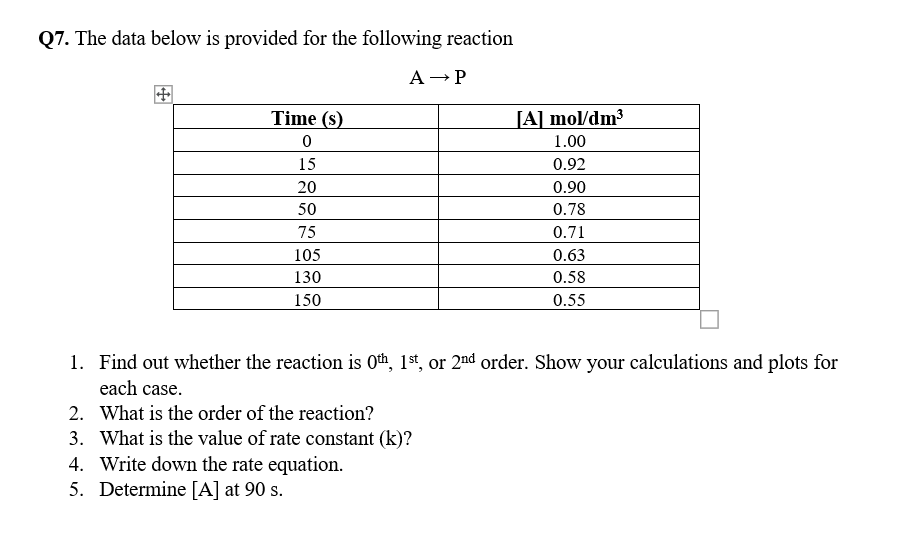
Q7. The data below is provided for the following reaction \( \mathrm{A} \rightarrow \mathrm{P} \) \begin{tabular}{|c|c|} \hline Time (s) & [A] \( \mathbf{m o l} / \mathbf{d m}^{\mathbf{3}} \) \\ \hline 0 & \( 1.00 \) \\ \hline 15 & \( 0.92 \) \\ \hline 20 & \( 0.90 \) \\ \hline 50 & \( 0.78 \) \\ \hline 75 & \( 0.71 \) \\ \hline 105 & \( 0.63 \) \\ \hline 130 & \( 0.58 \) \\ \hline 150 & \( 0.55 \) \\ \hline \end{tabular} 1. Find out whether the reaction is \( 0^{\text {th }}, 1^{\text {st }} \), or \( 2^{\text {nd }} \) order. Show your calculations and plots for each case. 2. What is the order of the reaction? 3. What is the value of rate constant \( (\mathrm{k}) \) ? 4. Write down the rate equation. 5. Determine \( [\mathrm{A}] \) at \( 90 \mathrm{~s} \).
View Answer
divider
INSTANT ANSWER

Q6. The experimental results of the decomposition of ethylene oxide: are presented in the following table: 1. What is the initial pressure of the reaction? 2. Prove that the reaction is first order using a graph that you can draw based on the given data. 3. Calculate the rate constant \( (\mathrm{k}) \) 4. What is the half-life time of this reaction?

View Answer
divider