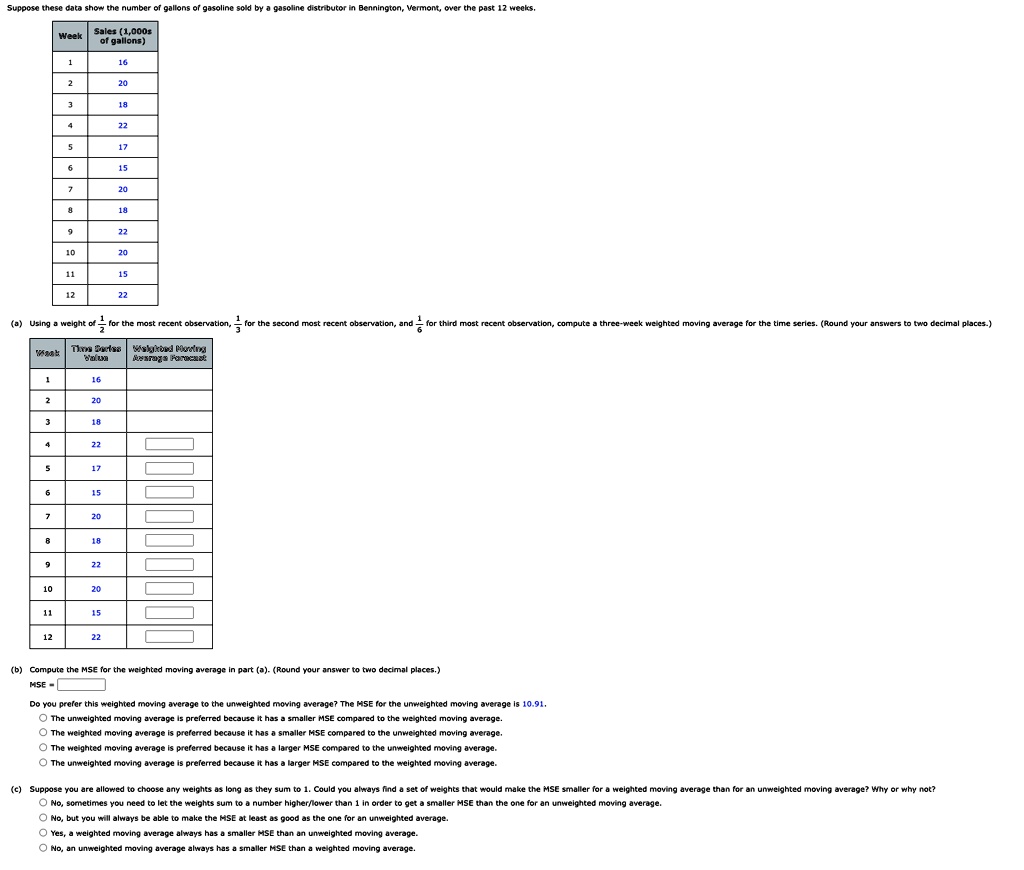
(b) Compute the MSE for the weighted moving average in part (a). (Round your answer to two decimal places.)
MSE =
Do you prefer this weighted moving average to the unweighted moving average? The MSE for the unweighted moving average is 10.91.
The unweighted moving average is preferred because it has a smaller MSE compared to the weighted moving average.
The weighted moving average is preferred because it has a smaller MSE compared to the unweighted moving average.
The weighted moving average is preferred because it has a larger MSE compared to the unweighted moving average.
The unweighted moving average is preferred because it has a larger MSE compared to the weighted moving average.
No, sometimes you need to let the weights sum to a number higher/lower than 1 in order to get a smaller MSE than the one for an unweighted moving average.
No, but you will always be able to make the MSE at least as good as the one for an unweighted average.
Yes, a weighted moving average always has a smaller MSE than an unweighted moving average.
No, an unweighted moving average always has a smaller MSE than a weighted moving average.
Suppose these data show the number of gallons of gasoline sold by a distributor in Bennington, Vermont, over the past 12 weeks:
Week
Sales (1,000s of gallons)
1
16 20 18 22 17 15 20 18 22 20 15 22
2
3
4
5
6
7
8
9
10
11
12
Using a weight of 0.6 for the most recent observation:
Week
Sales Weighted Percentage
16 20 18 22
17
15
20
18
22
20
15
22
(b) Compute the MSE for the weighted moving average in part (a). (Round your answer to two decimal places.) MSE =
The unweighted moving average is preferred because it has a smaller MSE compared to the weighted moving average.
The weighted moving average is preferred because it has a smaller MSE compared to the unweighted moving average.
The weighted moving average is preferred because it has a larger MSE compared to the unweighted moving average.
The unweighted moving average is preferred because it has a larger MSE compared to the weighted moving average.
(c) Suppose you are allowed to choose any weights as long as they sum to 1. Could you always find a set of weights that would make the MSE smaller for a weighted moving average than for an unweighted moving average? Why or why not?
No, sometimes you need to let the weights sum to a number higher/lower than 1 in order to get a smaller MSE than the one for an unweighted moving average.
No, but you will always be able to make the MSE at least as good as the one for an unweighted average.
Yes, a weighted moving average always has a smaller MSE than an unweighted moving average.
No, an unweighted moving average always has a smaller MSE than a weighted moving average.