Ace - AI Tutor
Ask Our Educators
Textbooks
My Library
Flashcards
Scribe - AI Notes
Notes & Exams
Download App
f-tima shaw

f-tima s.

Divider

Questions asked

BEST MATCH

Indicate whether each of the following transactions would increase (+), decrease (-), or not affect (N/A) total assets, total liabilities, and total stockholders equity.

View Answer
divider
BEST MATCH

Why is it important to match the appropriate-size blood pressure cuff to the person's arm and shape?Using a cuff that is too narrow will give a false reading that is high.Using a cuff that is too wide will give a false reading that is high.Using a cuff that is too narrow will give a false reading that is low

View Answer
divider
BEST MATCH

7. Can a bacterial culture be described as both membranous and turbid? Explain.

View Answer
divider
BEST MATCH

Question 37 If you want to filter results in a SQL you will use ____ clause. SELECT FROM ORDER BY WHERE

View Answer
divider
BEST MATCH

What type of entry condition exists if structural entry barriers are low, and either (1) entry-deterring strategies will be ineffective or (2) the cost to the incumbent of trying to deter entry exceeds the benefits it could gain from keeping the entrant out? Group of answer choices Judo Entry Deterred Entry Stealth Entry Blockaded Entry Accommodated Entry

View Answer
divider
BEST MATCH

Answer: 2tsp

View Answer
divider
BEST MATCH

12. A rechargeable battery is used to run some lights. The lights provide a load of 45 W to the battery. While running the lights the voltage across the terminals of the battery is 3.7 V. The battery charger which is used to charge the battery delivers 12 A at a voltage of 5.0 V. ? r r charger ? lights How much current flows when the lights are connected to the battery? Find the emf of the battery ($\mathcal{E}$) and its internal resistance ($r$). As part of your solution write down an expression for each circuit using Kirchhoff's loop rule.

View Answer
divider
BEST MATCH

(2) Let $f(x) = -3\sin(\frac{1}{4}x + \frac{\pi}{2})$. (a) Find the amplitude, period, and phase shift of $f$; (b) Find the five special points on the graph of $y = f(x)$ in the first period. (c) Sketch the graph of $y = f(x)$ in two complete period. (d) State how you can obtain the graph of $y = f(x)$ based on the graph the the basic sine function $y \sin x$; (e) And then determine the domain and range of $f(x)$.

View Answer
divider
BEST MATCH

Determine the lift force coefficient $C_{LHF}$ required for horizontal steady flight if: - Engine thrust is P=8300 N, - Flight velocity is M=0.7, - Flight altitude is H=0 km, - Aircraft drag force is $X_a$= 3700 N, - Aircraft Lift force is $Y_a$= 15303 N, - Aircraft mass is m=12000 kg, - Aircraft's wing area is S=70 $m^2$, - Attack angle $\alpha$=10$^o$, 3,14 1,29 1 0,38 0,048 0,74

View Answer
divider
BEST MATCH

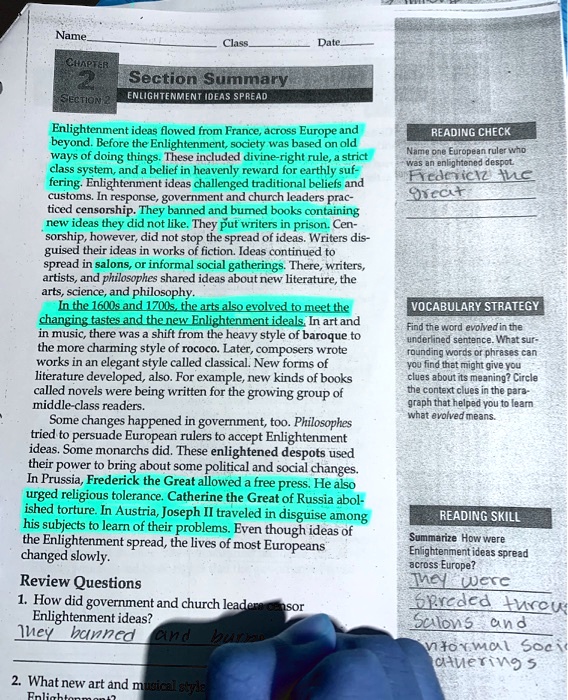
Name: [Name] Class: [Class] Date: [Date] NHAOTE Section: ENLIGHTENMENT IDEAS SPREAD Enlightenment ideas flowed from France, across Europe and beyond. Before the Enlightenment, society was based on old ways of doing things. These included divine-right rule, a strict class system, and a belief in heavenly reward for earthly suffering. Enlightenment ideas challenged traditional beliefs and customs. In response, government and church leaders practiced censorship. They banned and burned books containing new ideas they did not like. They put writers in prison. Censorship, however, did not stop the spread of ideas. Writers disguised their ideas in works of fiction. Ideas continued to spread in salons, or informal social gatherings. There, writers, artists, and philosophes shared ideas about new literature, the arts, science, and philosophy. In the 1600s and 1700s, the arts also evolved to meet the changing tastes and the new Enlightenment ideals. In art and in music, there was a shift from the heavy style of baroque to the more charming style of rococo. Later, composers wrote works in an elegant style called classical. New forms of literature developed, also. For example, new kinds of books called novels were being written for the growing group of middle-class readers. Some changes happened in government, too. Philosophes tried to persuade European rulers to accept Enlightenment ideas. Some monarchs did. These enlightened despots used their power to bring about some political and social changes. In Prussia, Frederick the Great allowed a free press. He also urged religious tolerance. Catherine the Great of Russia abolished torture. In Austria, Joseph II traveled in disguise among his subjects to learn of their problems. Even though ideas of the Enlightenment spread, the lives of most Europeans changed slowly. Review Questions: 1. How did government and church leaders respond to Enlightenment ideas? 2. Name one European ruler who was an enlightened despot. READING CHECK: Name one European ruler who was an enlightened despot: Frederick the Great VOCABULARY STRATEGY: Find the word "evolved" in the underlined sentence. What surrounding words or phrases can you find that might give you clues about its meaning? Circle the context clues in the paragraph that helped you to learn what "evolved" means. READING SKILL: Summarize: How were Enlightenment ideas spread across Europe? They were spread through salons and informal social gatherings.
View Answer
divider