Can you solve my question by explaining the steps to me one by one?
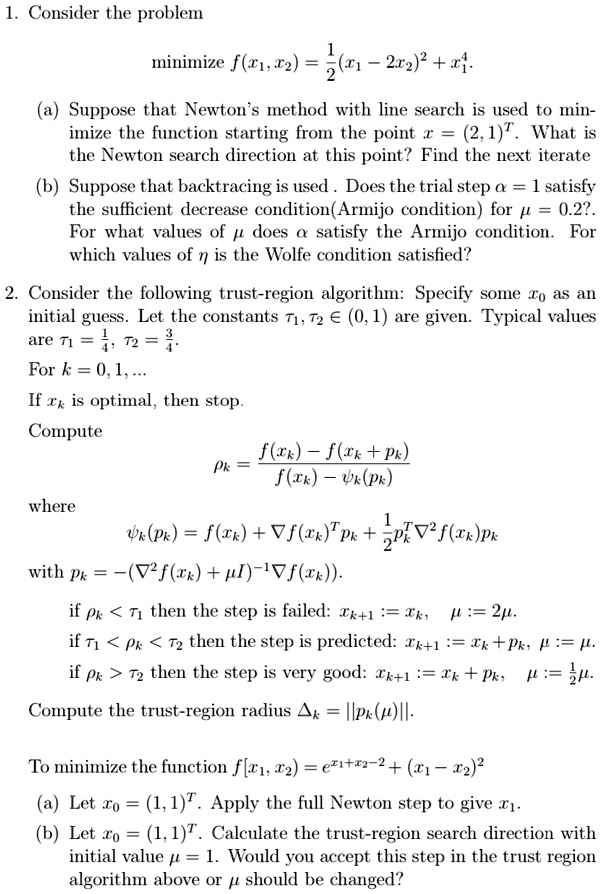
1. Consider the problem:
minimize f(x1, x2) = x1 - 2x
(a) Suppose that Newton's method with line search is used to minimize the function starting from the point x = (2,1)T. What is the Newton search direction at this point? Find the next iterate.
(b) Suppose that backtracking is used. Does the trial step a = 1 satisfy the sufficient decrease condition (Armijo condition) for α = 0.2? For what values of α does α satisfy the Armijo condition? For which values of n is the Wolfe condition satisfied?
2. Consider the following trust-region algorithm: Specify some xo as an initial guess. Let the constants T1, T2 (0, 1) are given. Typical values.
For k = 0, 1,... If α is optimal, then stop. Compute f(x) - f(xk + pk) pk = f(xk) - k(pk) where Vk(pk) = f(xk) + ∇f(xk)Tpk + 0.5pk∇2f(x)pk with pk = -(∇2f(x) + I)^(-1)∇f(x)).
If k < T1 then the step is failed: x+1 := xk. if T1 < α < T2 then the step is predicted: x+1 := xk + pk. if k > T2 then the step is very good: x+1 := xk + pk.
Compute the trust-region radius Δ = ||p()||.
To minimize the function f[x1, x2) = ex1 + x2 - 2 + (x1 - x2)^2
(a) Let xo = (1,1)T. Apply the full Newton step to give 1.
(b) Let xo = (1,1)T. Calculate the trust-region search direction with initial value Δ = 1. Would you accept this step in the trust region algorithm above or should it be changed?