Connect Problem CP 25-08
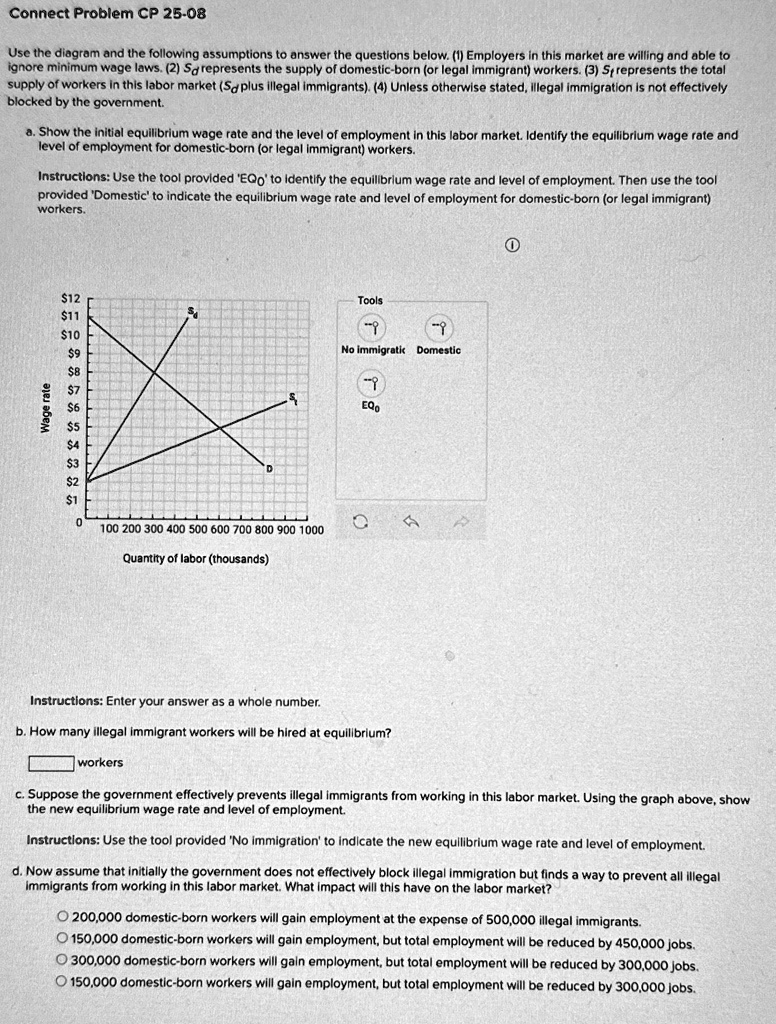
Use the diagram and the following assumptions to answer the questions below. (1) Employers in this market are willing and able to ignore minimum wage laws. (2) S_(d) represents the supply of domestic-born (or legal immigrant) workers. (3) S_(t) represents the total supply of workers in this labor market (S_(d) plus illegal immigrants). (4) Unless otherwise stated, illegal immigration is not effectively blocked by the government.
a. Show the initial equilibrium wage rate and the level of employment in this labor market. Identify the equilibrium wage rate and level of employment for domestic-born (or legal immigrant) workers.
Instructions: Use the tool provided 'EQ_(O)' to identify the equilibrium wage rate and level of employment. Then use the tool provided 'Domestic' to indicate the equilibrium wage rate and level of employment for domestic-born (or legal immigrant) workers.
(1)
Quantity of labor (thousands)
Instructions: Enter your answer as a whole number.
b. How many illegal immigrant workers will be hired at equilibrium?
workers
c. Suppose the government effectively prevents illegal immigrants from working in this labor market. Using the graph above, show the new equilibrium wage rate and level of employment.
Instructions: Use the tool provided 'No immigration' to indicate the new equilibrium wage rate and level of employment.
d. Now assume that initially the government does not effectively block illegal immigration but finds a way to prevent all illegal immigrants from working in this labor market. What impact will this have on the labor market?
200,000 domestic-born workers will gain employment at the expense of 500,000 illegal immigrants. 150,000 domestic-born workers will gain employment, but total employment will be reduced by 450,000 jobs. 300,000 domestic-born workers will gain employment, but total employment will be reduced by 300,000 jobs. 150,000 domestic-born workers will gain employment, but total employment will be reduced by 300,000 jobs.