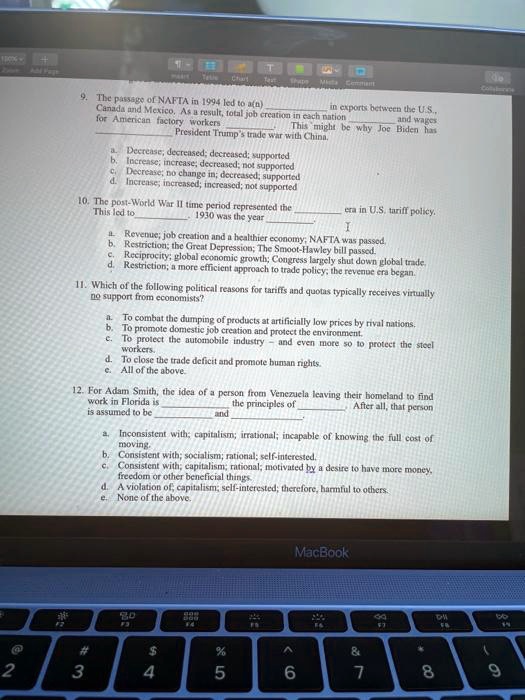
9. The passage of NAFTA in 1994 led to a(n) ____ in exports between the U.S., Canada and Mexico. As a result, total job creation in each nation ____ and wages ____ for American factory workers. This might be why Joe Biden has ____ President Trump's trade war with China.
a. Decrease; decreased; decreased; supported
b. Increase; increase, decreased, not supported
c. Decrease; no change in; decreased; supported
d. Increase; increased; increased; not supported
10. The post-World War II time period represented the ____ era in U.S. tariff policy. This led to ____. 1930 was the year ____.
a. Revenue; job creation and a healthier economy; NAFTA was passed.
b. Restriction; the Great Depression; The Smoot-Hawley bill passed.
c. Reciprocity; global economic growth; Congress largely shut down global trade.
d. Restriction; a more efficient approach to trade policy; the revenue era began.
11. Which of the following political reasons for tariffs and quotas typically receives virtually no support from economists?
a. To combat the dumping of products at artificially low prices by rival nations.
b. To promote domestic job creation and protect the environment.
c. To protect the automobile industry and even more so to protect the steel workers.
d. To close the trade deficit and promote human rights.
e. All of the above.
12. For Adam Smith, the idea of a person from Venezuela leaving their homeland to find work in Florida is ____ and ____ the principles of ____. After all, that person is assumed to be ____.
a. Inconsistent with; capitalism; irrational; incapable of knowing the full cost of moving.
b. Consistent with; socialism; rational; self-interested.
c. Consistent with; capitalism; rational; motivated by a desire to have more money, freedom or other beneficial things.
d. A violation of; capitalism; self-interested; therefore, harmful to others.
e. None of the above.