2. This question relates to solving a simple differential equation using matrix methods.
The personal data can be found on Moodle by running the MATLAB code. Using the
details of a differential equation and associated boundary conditions provided here,
you should determine the solution using matrix methods. Be sure to clearly annotate
your solutions including graphs and diagrams where necessary.
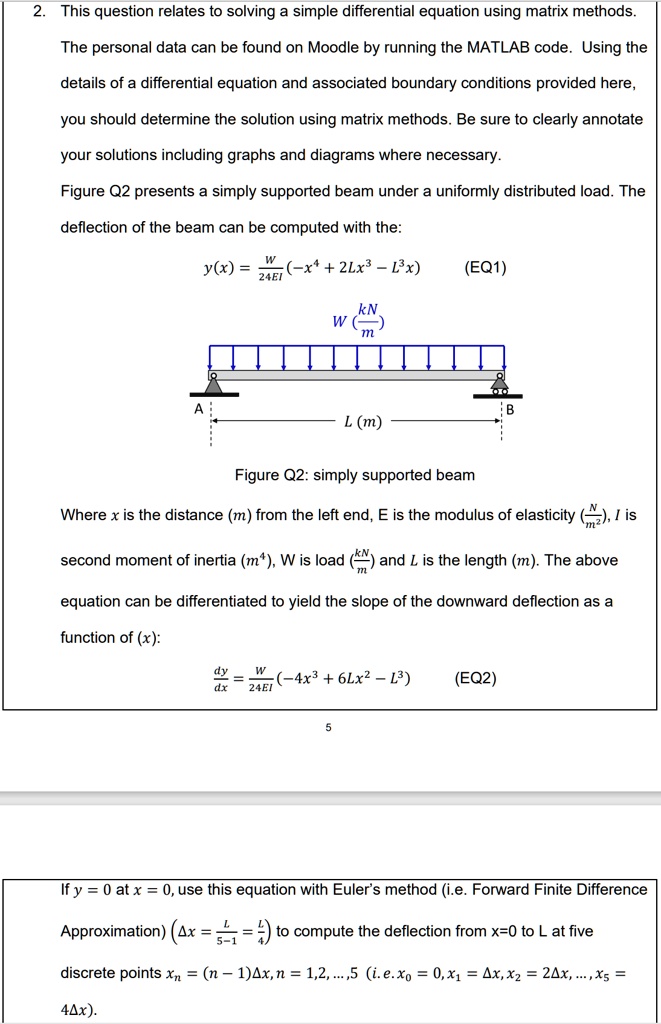
Figure Q2 presents a simply supported beam under a uniformly distributed load. The
deflection of the beam can be computed with the:
y(x) = \frac{W}{24EI}(-x^4 + 2Lx^3 - L^3x) \quad \text{(EQ1)}
Where x is the distance (m) from the left end, E is the modulus of elasticity ($\frac{N}{m^2}$), I is
second moment of inertia ($m^4$), W is load ($\frac{kN}{m}$) and L is the length (m). The above
equation can be differentiated to yield the slope of the downward deflection as a
function of (x):
$\frac{dy}{dx} = \frac{W}{24EI}(-4x^3 + 6Lx^2 - L^3) \quad \text{(EQ2)}$
If y = 0 at x = 0, use this equation with Euler's method (i.e. Forward Finite Difference
Approximation) ($\Delta x = \frac{L}{5-1} = \frac{L}{4}$) to compute the deflection from x=0 to L at five
discrete points $x_n = (n - 1)\Delta x$, n = 1,2,...,5 (i.e.$x_0 = 0, x_1 = \Delta x, x_2 = 2\Delta x, ..., x_5 = 4\Delta x$).