Ace - AI Tutor
Ask Our Educators
Textbooks
My Library
Flashcards
Scribe - AI Notes
Notes & Exams
Download App
felix watkins

felix w.

Divider

Questions asked

BEST MATCH

3. Engineering Problem 3: In thermal analysis, engineers need to determine the direction of heat flow in a temperature field where heat naturally moves in the direction of the greatest decrease in temperature. Given the temperature distribution $T = 3x^2 - 2y^2$, engineers must find the general direction of heat flow by computing the gradient of the temperature field $\nabla T$, and evaluate it at the point $P(2.5, 1.8)$. This information will be critical for thermal management and optimizing the placement of cooling systems in the design.

View Answer
divider
BEST MATCH

The triceps muscle at the back of her upper arm has an effective lever arm of 1.75 cm, and she exerts force on the floor at a horizontal distance of 20.0 cm from the elbow joint. Calculate the magnitude of the force in each triceps muscle. Assume that she moves up at a constant speed. $m = 50.0 \, kg$ 0.90 m 1.50 m

View Answer
divider
BEST MATCH

Question 2 Which is true regarding Okazaki fragments during DNA synthesis? A They occur on the leading strand. B They are needed because DNA is always synthesized in a 5' to 3' direction. C They are necessitated by the fact that DNA synthesis initiates with an RNA primer. D None of the above.

View Answer
divider
BEST MATCH

The longest palindromic subsequence problem is a classic variation of the Longest Common Subsequence (LCS) problem. The idea is to find the LCS of the given string with its reverse, i.e., call LCS(X, reverse(X)), and the longest common subsequence will be the longest palindromic subsequence. 1. We consider the sequence X = ABBDCACB. Apply the appropriate dynamic programming algorithm to compute the longest palindromic sequence, including its length. You must show all the computing steps.

View Answer
divider
BEST MATCH

A significant lag for fiscal policy is the time it takes to pass legislation authorizing it. Group of answer choices True False

View Answer
divider
BEST MATCH

Which of the following is correct? A. Real rate of interest = Nominal rate of interest + Anticipated rate of inflation B. Nominal rate of interest + Real rate of interest = Anticipated rate of inflation C. Real rate of interest = Nominal rate of interest - Anticipated rate of inflation D. Nominal rate of interest * Real rate of interest * Anticipated rate of inflation A. Real rate of interest = (Nominal rate of interest + Anticipated rate of inflation) Which of the following is correct?

View Answer
divider
BEST MATCH

Two areas of the brain that regulate the responses of the autonomic nervous system are the Question 42 options: cerebrum and cerebellum. hypothalamus and medulla oblongata. anterior pituitary and posterior pituitary. corpus callosum and thalamus

View Answer
divider
BEST MATCH

OMT Inc. is planning to issue a $1,000 face-value bond with an annual coupon rate of 7% that matures in 10 years. OMT is planning to pay semi-annual interest payments. Similar OMT bonds are quoting at 98.5% of par. What is the price that bondholders will pay for this bond?

View Answer
divider
BEST MATCH

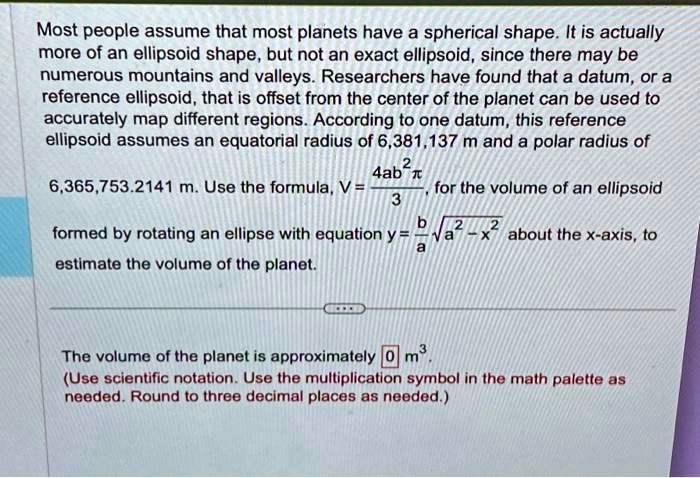
Most people assume that most planets have a spherical shape. It is actually more of an ellipsoid shape, but not an exact ellipsoid, since there may be numerous mountains and valleys. Researchers have found that a datum, or a reference ellipsoid, that is offset from the center of the planet can be used to accurately map different regions. According to one datum, this reference ellipsoid assumes an equatorial radius of 6,381,137 m and a polar radius of 6,365,753.2141 m. Use the formula, $V = \frac{4ab^2\pi}{3}$, for the volume of an ellipsoid formed by rotating an ellipse with equation $y = \frac{b}{a}\sqrt{a^2 - x^2}$ about the x-axis, to estimate the volume of the planet. The volume of the planet is approximately 0 m$^3$. (Use scientific notation. Use the multiplication symbol in the math palette as needed. Round to three decimal places as needed.)
View Answer
divider
BEST MATCH

Figure 2: A. Answer the following questions regarding Figure 2: 11. What is the transverse plane position of the lumbar spine in figure A? 12. What is the transverse plane position of the lumbar spine in figure B? 13. What is the transverse plane movement of the lumbar spine from figure A to B? 14. Name a muscle which causes the transverse plane movement of the lumbar spine from Figure A to Figure B 15. What is the sagittal plane position of the right elbow in figure A? 16. What is the sagittal plane position of the right elbow in figure B? 17. What is the sagittal plane movement of the right elbow from figure A to B? 18. Name a muscle which causes the sagittal plane movement of the right elbow from Figure A to Figure B 19. What is the sagittal plane movement of the right wrist from figure A to B? 20. Name a muscle which causes the sagittal plane movement of the right wrist from Figure A to Figure B 21. What is the sagittal plane position of the right knee in figure A? 22. What is the sagittal plane position of the right knee in figure B? 23. What is the sagittal plane movement of the right knee from figure A to B? 24. Name a muscle which causes the sagittal plane movement of the right knee from Figure A to Figure B 25. What is the transverse plane position of the right hip in figure A? 26. What is the transverse plane position of the right hip in figure B? 27. What is the transverse plane movement of the right hip from figure A to B? 28. Name a muscle which causes the transverse plane movement of the right hip from Figure A to Figure B

View Answer
divider