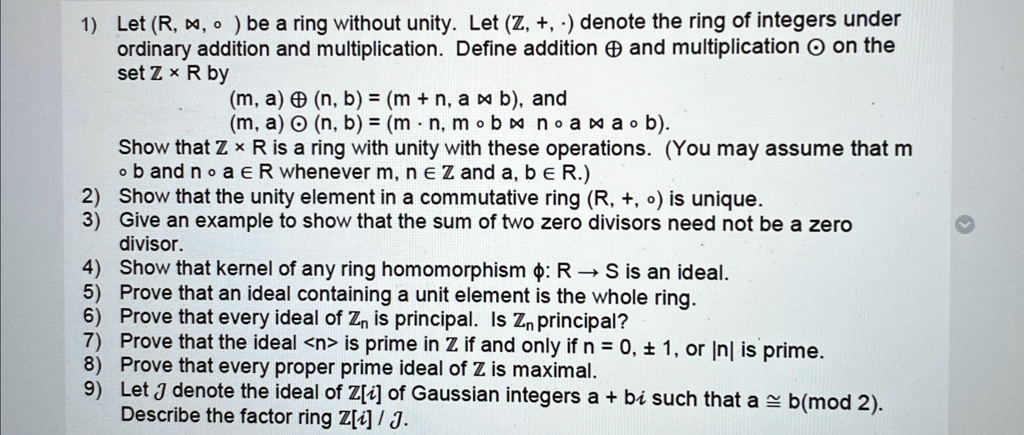
1) Let $(R, \times, \circ)$ be a ring without unity. Let $(Z, +, \cdot)$ denote the ring of integers under
ordinary addition and multiplication. Define addition $\oplus$ and multiplication $\odot$ on the
set $Z \times R$ by
$(m, a) \oplus (n, b) = (m + n, a \times b)$, and
$(m, a) \odot (n, b) = (m \cdot n, m \circ b \times n \circ a \times a \circ b)$.
Show that $Z \times R$ is a ring with unity with these operations. (You may assume that $m \circ b$ and $n \circ a \in R$ whenever $m, n \in Z$ and $a, b \in R$.)
2) Show that the unity element in a commutative ring $(R, +, \circ)$ is unique.
3) Give an example to show that the sum of two zero divisors need not be a zero
divisor.
4) Show that kernel of any ring homomorphism $\phi: R \to S$ is an ideal.
5) Prove that an ideal containing a unit element is the whole ring.
6) Prove that every ideal of $Z_n$ is principal. Is $Z_n$ principal?
7) Prove that the ideal $<n>$ is prime in $Z$ if and only if $n = 0, \pm 1$, or $|n|$ is prime.
8) Prove that every proper prime ideal of $Z$ is maximal.
9) Let $J$ denote the ideal of $Z[i]$ of Gaussian integers $a + bi$ such that $a \equiv b (mod \ 2)$.
Describe the factor ring $Z[i] / J$.