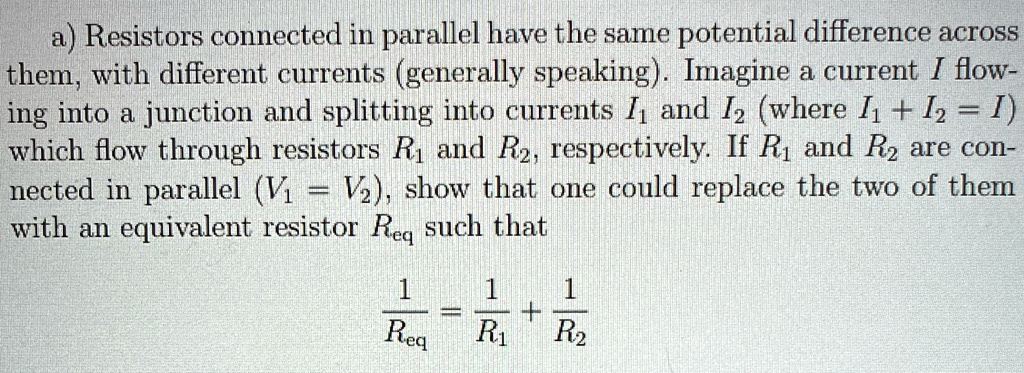
a) Resistors connected in parallel have the same potential difference across them, with different currents (generally speaking). Imagine a current $I$ flowing into a junction and splitting into currents $I_1$ and $I_2$ (where $I_1 + I_2 = I$) which flow through resistors $R_1$ and $R_2$, respectively. If $R_1$ and $R_2$ are connected in parallel ($V_1 = V_2$), show that one could replace the two of them with an equivalent resistor $R_{eq}$ such that \\
$\frac{1}{R_{eq}} = \frac{1}{R_1} + \frac{1}{R_2}$