When a country has a comparative advantage in the production of a good, it means that it can produce this good at a lower opportunity cost than its
trading partner. Then the country will specialize in the production of this good and trade it for other goods.
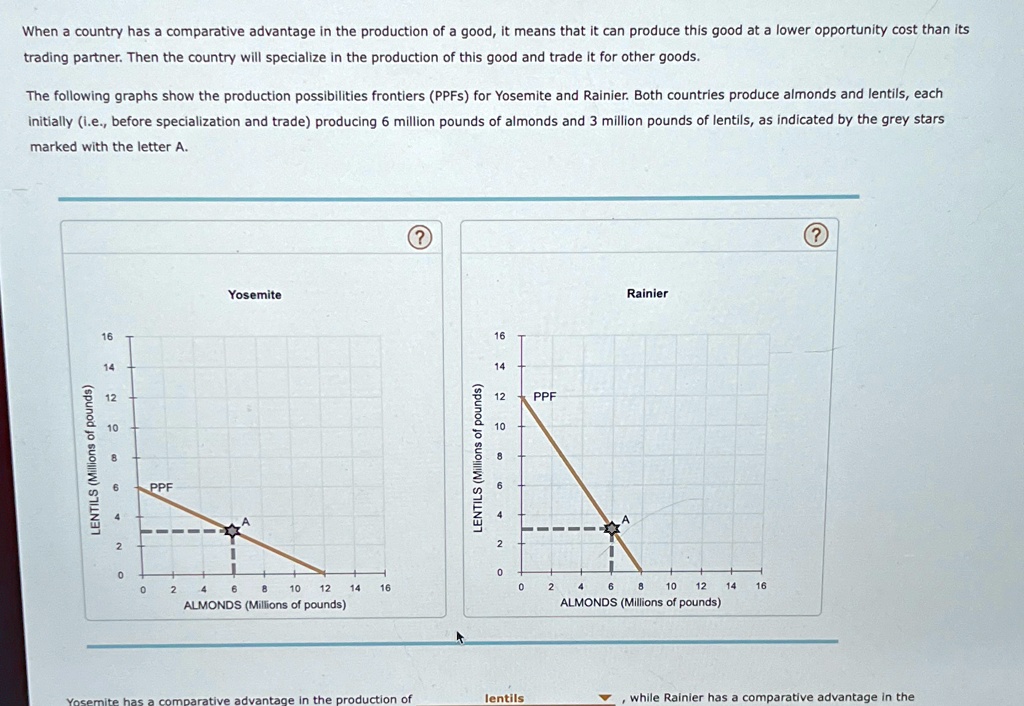
The following graphs show the production possibilities frontiers (PPFs) for Yosemite and Rainier. Both countries produce almonds and lentils, each
initially (i.e., before specialization and trade) producing 6 million pounds of almonds and 3 million pounds of lentils, as indicated by the grey stars
marked with the letter A.
LENTILS (Millions of pounds)
16
14
12
10
8
6
PPF
Yosemite
A
2
0
0
2
4
6
8
10
12
14
16
ALMONDS (Millions of pounds)
LENTILS (Millions of pounds)
16
14
12
10
8
PPF
Rainier
A
6
4
2
0
0
2
4
6
8
10
12
14
16
ALMONDS (Millions of pounds)
Yosemite has a comparative advantage in the production of
lentils
?, while Rainier has a comparative advantage in the