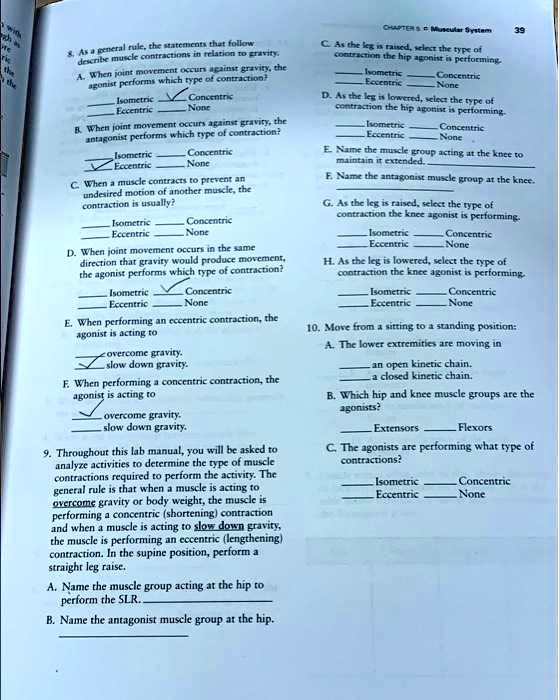
39 C As the leg is raised, select the type of contraction the hip agonist is performing. Concentric Eccentric None D. As the leg is lowered, select the type of contraction the hip agonist is performing. Concentric Eccentric None E. Name the muscle group acting at the knee to maintain it extended. E. Name the antagonist muscle group at the knee.
A. When joint movement occurs against gravity, the agonist performs which type of contraction? Isometric Concentric Eccentric None B. When joint movement occurs against gravity, the agonist performs which type of contraction? Isometric Concentric Eccentric None C. When a muscle contracts to prevent an undesired motion of another muscle, the contraction is usually Isometric Concentric Eccentric None D. When joint movement occurs in the same direction that gravity would produce movement, the agonist performs which type of contraction? Isometric Concentric Eccentric None E. When performing an eccentric contraction, the agonist is acting to overcome gravity slow down gravity F. When performing a concentric contraction, the agonist is acting to overcome gravity slow down gravity.
G. As the leg is raised, select the type of contraction the knee agonist is performing. Isometric Concentric Eccentric None H. As the leg is lowered, select the type of contraction the knee agonist is performing. Isometric Eccentric Concentric None
10. Move from a sitting to a standing position A. The lower extremities are moving in an open kinetic chain a closed kinetic chain. B. Which hip and knee muscle groups are the agonists? Extensors Flexors C. The agonists are performing what type of contractions?
9. Throughout this lab manual, you will be asked to analyze activities to determine the type of muscle contractions required to perform the activity. The general rule is that when a muscle is acting to overcome gravity or body weight, the muscle is performing a concentric (shortening) contraction and when a muscle is acting to slow down gravity, the muscle is performing an eccentric (lengthening) contraction. In the supine position, perform a straight leg raise. A. Name the muscle group acting at the hip to perform the SLR B. Name the antagonist muscle group at the hip
Isometric Eccentric Concentric None