Questions asked
Match each adaptation to the appropriate species Question 15 options: 12345 Moose 12345 Tree Cricket 12345 Hairy Woodpecker 12345 Sandhill Crane 12345 Wilson's Snipe 1. drumming 2. wallow pit 3. winnowing 4. stridulation 5. elaborate dances
The behavioral perspective on psychological disorders assumes that abnormal behaviors are
The term for passage of visibly bloody feces is: O a. dysentery. O b. hematemesis. O c. stoma. O d. hematochezia.
Select the option that best describes metastasis. Cancer cells are deposited into body cavities. Crablike projections of cancer cells invade the surrounding tissue. The development of a secondary tumor. Hyperplastic cellular changes.
5.a. Explain the features of the following parallel Architectures. i. Distributed Memory Architecture. ii. Multicore Computing Architecture.
Negative externalities, such as pollution, ______ the utility of those affected. Multiple choice question. increase maximize eliminate reduce
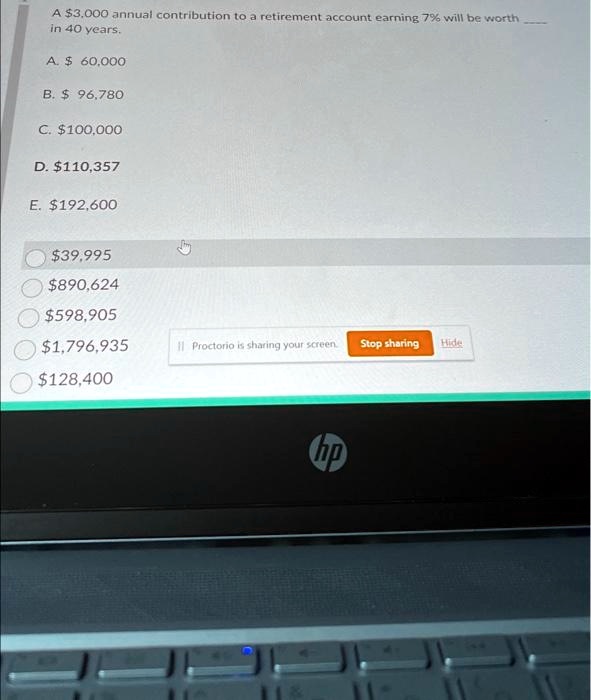
A $3,000 annual contribution to a retirement account earning 7% will be worth ____ in 40 years. A. $ 60,000 B. $ 96,780 C. $100,000 D. $110,357 E. $192,600 $39,995 $890,624 $598,905 $1,796,935 $128,400
Given the following function: def reverse_str(st, pos=0): Returns a new string that is the reverse of st When first called, the pos parameter must be zero if pos == len(st): return "" return reverse_str(st, pos+1) + st[pos] If a user were to call the function like this reverse_str("recursion") What would be the value of pos in the first call? Nothing; an error would occur. 0 "recursion" 1
4 DON Corp. is contemplating the purchase of a machine that will produce net after-tax cash savings of $24,000 per year for 4 years. At the end of four years, the machine can be sold to realize after-tax cash flows of $5,400. Assuming a 9% discount rate, calculate the total present value of the cash inflows and the cash savings from the machine. (FV of $1, PV of $1, FVA of $1, and PVA of $1). (Use appropriate factor(s) from the tables provided. Round final answer to the nearest whole dollar.) Total present value of the cash savings $ 3,826
The Maxwell-Jüttner distribution and the expanding universe The Maxwell-Boltzmann distribution of speeds is the equilibrium distribution of speeds for a distinguishable set of particles, moving with non-relativistic speeds. In this question, you will show that the relativistic form of this distribution - the Maxwell-Jüttner distribution - reduces to the Maxwell-Boltzmann distribution in the limit of low speeds: by this, we mean that the rest mass energy of the particles is much greater than their kinetic energy or k << mc. You will then compare the Maxwell-Jüttner distribution with the Planck distribution for photons in the limit when the particle speeds are highly relativistic so that kT >> mc^2. (a) Show that the Maxwell-Boltzmann distribution, given in terms of speeds, 8 marks f(u)du = 2kT can be written in terms of the magnitude of the non-relativistic momentum p as: f(u)du = f(p)dp = p'dp (Equation 1.1) (b) The Maxwell-Jüttner distribution can be written in terms of the Lorentz factor as: 12 marks f(u)du = K * z * e^(-z) (Equation 1.2) In this equation, K = K(T). The function K(z) is called an Intermediate Bessel function of the second kind. Rewrite equation 1.2 in terms of the relativistic momentum rather than y and z. We will look at the limit where the motion is classical so that kT << mc and therefore z is very much less than 1. Show that your new version of Equation 1.2 reduces to Equation 1.1 in this limiting case. Hints: a) For large arguments z, the function 1 b) The relativistic momentum is p = ymc and the relativistic energy is E = ymc^2 = mc^2 + pc.