Exercise 3: An Extensive Game with Perfect Information and Simultaneous Moves
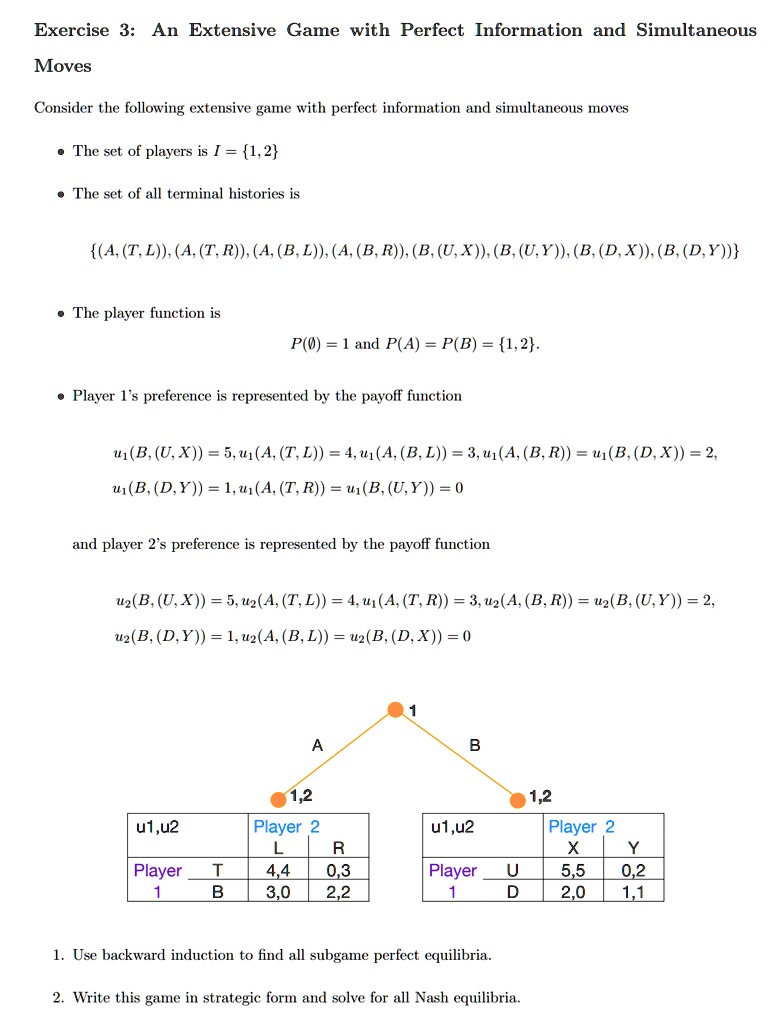
Consider the following extensive game with perfect information and simultaneous moves
• The set of players is $I = \{1, 2\}$
• The set of all terminal histories is
$\{(A, (T, L)), (A, (T, R)), (A, (B, L)), (A, (B, R)), (B, (U, X)), (B, (U, Y)), (B, (D, X)), (B, (D, Y))\}$
• The player function is
$P(0) = 1$ and $P(A) = P(B) = \{1, 2\}$.
• Player 1's preference is represented by the payoff function
$u_1(B, (U, X)) = 5, u_1(A, (T, L)) = 4, u_1(A, (B, L)) = 3, u_1(A, (B, R)) = u_1(B, (D, X)) = 2,$
$u_1(B, (D, Y)) = 1, u_1(A, (T, R)) = u_1(B, (U, Y)) = 0$
and player 2's preference is represented by the payoff function
$u_2(B, (U, X)) = 5, u_2(A, (T, L)) = 4, u_1(A, (T, R)) = 3, u_2(A, (B, R)) = u_2(B, (U, Y)) = 2,$
$u_2(B, (D, Y)) = 1, u_2(A, (B, L)) = u_2(B, (D, X)) = 0$
1. Use backward induction to find all subgame perfect equilibria.
2. Write this game in strategic form and solve for all Nash equilibria.