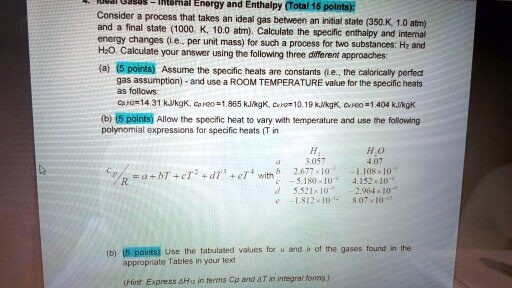
4. Ideal Gases - Internal Energy and Enthalpy (Total 15 points):
Consider a process that takes an ideal gas between an initial state (350.K, 1.0 atm)
and a final state (1000. K, 10.0 atm). Calculate the specific enthalpy and internal
energy changes (i.e., per unit mass) for such a process for two substances: H? and
H?O. Calculate your answer using the following three different approaches:
(a) (5 points) Assume the specific heats are constants (i.e., the calorically perfect
gas assumption) - and use a ROOM TEMPERATURE value for the specific heats
as follows:
$C_{p,H_2}$=14.31 kJ/kgK, $C_{p,H_2O}$=1.865 kJ/kgK, $C_{v,H_2}$=10.19 kJ/kgK, $C_{v,H_2O}$=1.404 kJ/kgK
(b) (5 points) Allow the specific heat to vary with temperature and use the following
polynomial expressions for specific heats (T in
$\frac{C_p}{R} = a + bT + cT^2 + dT^3 + eT^4$ with
\begin{tabular}{c|c|c}
& $H_2$ & $H_2O$ \\
\hline
a & 3.057 & 4.07 \\
b & $2.677 \times 10^{-3}$ & $-1.108 \times 10^{-2}$ \\
c & $-5.180 \times 10^{-6}$ & $4.152 \times 10^{-5}$ \\
d & $5.521 \times 10^{-9}$ & $2.964 \times 10^{-8}$ \\
e & $-1.812 \times 10^{-12}$ & $8.07 \times 10^{-13}$ \\
\end{tabular}
(b) (5 points) Use the tabulated values for $\mu$ and $\upsilon$ of the gases found in the
appropriate Tables in your text
(Hint: Express $\Delta H$ in terms $C_p$ and $\Delta T$ in integral forms.)