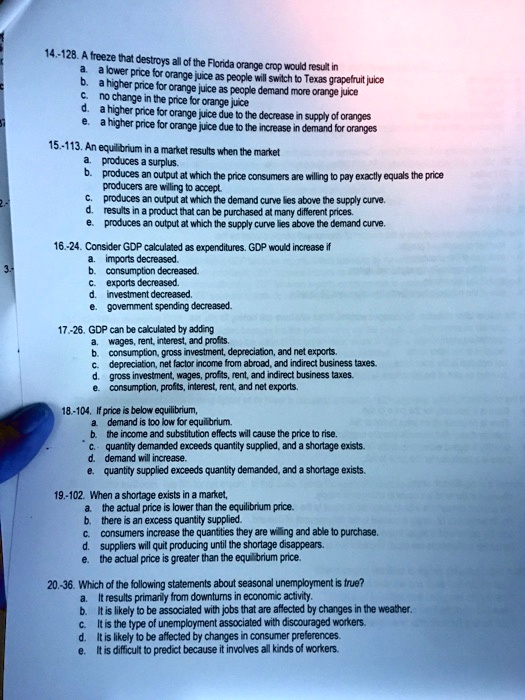
14.18. A freeze that destroys all of the Florida orange crop would result in C. no change in the price for orange juice.
15.-113. An equilibrium in a market results when the market produces a surplus. b. produces an output at which the price consumers are willing to pay exactly equals the price producers are willing to accept. C. produces an output at which the demand curve lies above the supply curve. e. produces an output at which the supply curve lies above the demand curve.
16.-24. Consider GDP calculated as expenditures. GDP would increase if a. imports decreased b. consumption decreased. C. exports decreased d. investment decreased. e. government spending decreased.
17.-26. GDP can be calculated by adding a. wages, rent, interest, and profits. b. consumption, gross investment, depreciation, and net exports depreciation, net factor income from abroad, and indirect business taxes d. gross investment, wages, profits, rent, and indirect business taxes. e. consumption profits, interest rent, and net exports.
18.-104. If price is below equilibrium a. demand is too low for equilibrium b. the income and substitution effects will cause the price to rise. C. quantity demanded exceeds quantity supplied, and a shortage exists d. demand will increase. e. quantity supplied exceeds quantity demanded, and a shortage exists.
19.-102. When a shortage exists in a market. a. the actual price is lower than the equilibrium price b. there is an excess quantity supplied. C. d. suppliers will quit producing until the shortage disappears. e. the actual price is greater than the equilibrium price.
20.-36. Which of the following statements about seasonal unemployment is true? a. It results primarily from downturns in economic activity. b. It is likely to be associated with jobs that are affected by changes in the weather c. It is the type of unemployment associated with discouraged workers. It is likely to be affected by changes in consumer preferences. It is difficult to predict because it involves all kinds of workers.