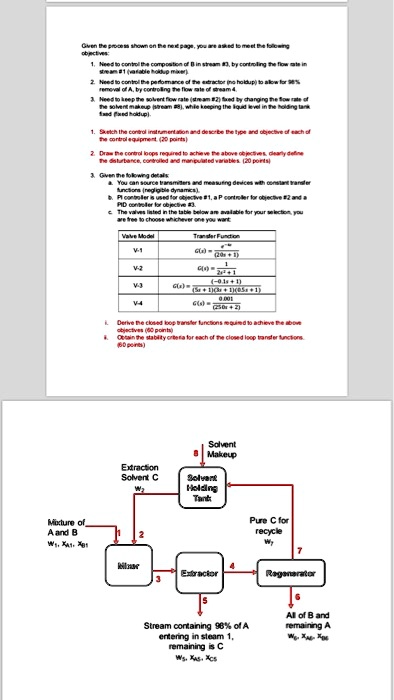
Given the process shown on the next page, you are asked to meet the following
objectives:
1. Need to control the composition of B in stream #3, by controlling the flow rate in
stream #1 (variable holdup mixer)
2. Need to control the performance of the extractor no holdup to allow for 98%
removal of A, by controlling the flow rate of stream #4.
3. Need to keep the solvent flow rate (stream #2) fixed by changing the flow rate of
the solvent makeup (stream #8), while keeping the liquid level in the holding tank
fixed (fixed holdup).
1. Sketch the control instrumentation and describe the type and objective of each of
the control equipment (20 points)
2. Draw the control loops required to achieve the above objectives, clearly define
the disturbance, controlled and manipulated variables (20 points)
3. Given the following details
a. You can source transmitters and measuring devices with constant transfer
functions (negligible dynamics).
b. P controller is used for objective #1, a P controller for objective #2 and a
PID controller for objective #3.
c. The valves listed in the table below are available for your selection, you
are free to choose whichever one you want
Valve Model Transfer Function
V-1 $G(s) = \frac{e^{-s}}{(20s+1)}$
V-2 $G(s) = \frac{1}{(2s+1)}$
V-3 $G(s) = \frac{(-0.1s+1)}{(5s+1)(3s+1)(0.5s+1)}$
V-4 $G(s) = \frac{0.001}{(25s+2)}$
Derive the closed loop transfer functions required to achieve the above
objectives (60 points)
Obtain the stability criteria for each of the closed loop transfer functions.
(60 points)
Mixture of
A and B
$W_1, x_{A1}, x_{B1}$Extraction
Solvent C
$W_2$
2
Solvent
8 Makeup
Solvent
Holding
Tank
Pure C for
recycle
$W_7$
7
3
Extractor
4
Regenerator
5
6
Stream containing 96% of A
entering in steam 1,
remaining is C
$W_5, x_{A5}, x_{C5}$All of B and
remaining A