Questions asked
What is the number of moles and the mass of the solute in the following solution? 2.00 L of 18.5-M $H_2SO_4$ (concentrated sulfuric acid) A 37 moles, 3629 g B 18.5 moles, 3629 g C 18.5 moles, 1700 g D 37 moles, 1700 g
Estimate the amount of heat (in kJ ) required to raise 5 kg of -iron from room temperature (25 C ) to 100 C .
Use Theorem 7.1.1 to find \(\mathcal{L}\{f(t)\}\). (Write your answer as a function of s.) \(f(t) = 5t - 11\)
Please help ASAP Draw the major organic product of the following reaction: major organic product? 1. Draw the major organic product of the following reaction: heat Br double E2 major organic product?
1. Management wants to know how the reported net cash provided by operating activities will differ under the direct method and indirect method. Which of the following is an accurate explanation? 2. During the year, Gadberry acquired a new building by issuing a note. Where on the statement of cash flows is this transaction reported? 3. Management is wondering how Nessly, which nearly went out of business this year, has a higher total net increase in cash than Gadberry. Further, Gadberry management claims that it had a great year and is expanding. Which of the following would explain Nessly's higher increase in cash? 4. Gadberry management is wondering how Tootsey, which just opened for business this year, has a higher total net increase in cash than Gadberry. Gadberry management claims that it had a great year and is expanding. Which of the following would explain Tootsey's higher increase in cash?
Use the Chain Rule to find $\frac{\partial z}{\partial s}$ and $\frac{\partial z}{\partial t}$. $z = \sin(\theta) \cos(\phi)$, $\theta = st^2$, $\phi = s^2t$ $\frac{\partial z}{\partial s} = $ $\frac{\partial z}{\partial t} = \cos \theta \cos \phi 9t^2s^2 - \sin \theta \sin \phi s^3$
Texts: Assignment 1: Problem 4 (1 point) Complex numbers z1 and z2 are given by z1 = -5 + j - 7 z2 = -7 + j - 5 (a) Express z1 and z2 in polar form. (b) Find |z1| and |z2|. (c) Determine the product z1 * z2 in polar form. (d) Determine the ratio z1/z2 in polar form. (e) Determine z1^4 in polar form (please input the phase part within the range of -179° < θ < 180°). Answers: (a) z1 = r1 * exp(jθ1) and z2 = r2 * exp(jθ2) (b) |z1| = r1 and |z2| = r2 (c) z1 * z2 = r1 * r2 * exp(j(θ1 + θ2)) (d) z1/z2 = (r1/r2) * exp(j(θ1 - θ2)) (e) z1^4 = r1^4 * exp(j(4θ1))
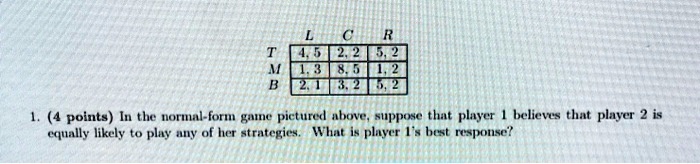
L C R T 4, 5 2, 2 5, 2 M 1, 3 8, 5 1, 2 B 2, 1 3, 2 5, 2 1. (4 points) In the normal-form game pictured above, suppose that player 1 believes that player 2 is equally likely to play any of her strategies. What is player 1's best response?
Q1: In a temperature scale the value of Fahrenheit scale reading is equals to twice the value of Celsius scale. What would be the value of temperature in Fahrenheit scale? How much this value in kelvin scale and Rankine scale? [4.0 Marks]
Draw structures corresponding to the following names: i. Ethyl 1-ethylpropyl ether ii. Di(p-chlorphenyl)ether iii. Cyclopentoxycyclohexane iv. (Z)-2-ethyl-2-buten-1-ol v. o-(2-hydroxyethyl)phenol vi. 1,4-Pentanediol