Ace - AI Tutor
Ask Our Educators
Textbooks
My Library
Flashcards
Scribe - AI Notes
Notes & Exams
Download App
frank koch

frank k.

Divider

Questions asked

BEST MATCH

hazily grabbed a peach and ripped it into 1/50 halves and she eats the rest how much does she have

View Answer
divider
BEST MATCH

Classical example of a separable first-order differential equation is: (1/cos(t))(dy/dt) - exp(y + sin(t)) = 0. Given an initial condition that y = 0 when at t = pi, you are asked to use Euler's method to approximate the value of y(t = 11*pi/10) and (t = 12*pi/10) minutes using a step size of h = delta t = pi/10.

View Answer
divider
BEST MATCH

Which of the following is an OTC antiemetic? Transderm Scop Zofran Nauzene Ativan

View Answer
divider
BEST MATCH

Which disorder is considered most common across all age groups? Multiple Choice Anorexia nervosa Binge-eating disorder Body dysmorphic disorder Bulimia nervosa

View Answer
divider
BEST MATCH

What is the complexity of given code segment below? public static void whoknows(int number1, int number2) { if(number1 < number2) System.out.println(number1); else if(number1 > number2) System.out.println(number2); else System.out.println(number1 == number2); } Your answer: O O(1) O O(n logn) O O(n) O O(log n)

View Answer
divider
BEST MATCH

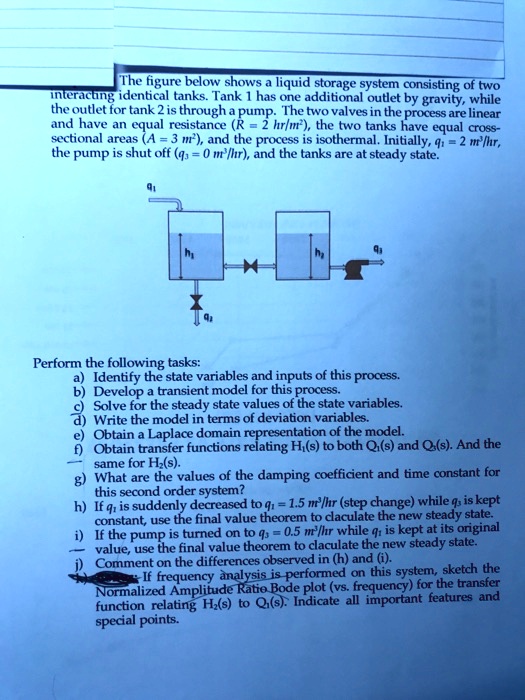
The figure below shows a liquid storage system consisting of two interacting identical tanks. Tank 1 has one additional outlet by gravity, while the outlet for tank 2 is through a pump. The two valves in the process are linear and have an equal resistance (R = 2 hr/m²), the two tanks have equal cross- sectional areas (A = 3 m²), and the process is isothermal. Initially, $q_1$ = 2 m³/hr, the pump is shut off ($q_3$=0 m³/hr), and the tanks are at steady state. Perform the following tasks: a) Identify the state variables and inputs of this process. b) Develop a transient model for this process. c) Solve for the steady state values of the state variables. d) Write the model in terms of deviation variables. e) Obtain a Laplace domain representation of the model. f) Obtain transfer functions relating $H_1(s)$ to both $Q_1(s)$ and $Q_3(s)$. And the same for $H_2(s)$. g) What are the values of the damping coefficient and time constant for this second order system? h) If $q_1$ is suddenly decreased to $q_1$ = 1.5 m³/hr (step change) while $q_3$ is kept constant, use the final value theorem to claculate the new steady state. i) If the pump is turned on to $q_3$ = 0.5 m³/hr while $q_1$ is kept at its original value, use the final value theorem to claculate the new steady state. j) Comment on the differences observed in (h) and (i). If frequency analysis is performed on this system, sketch the Normalized Amplitude Ratio Bode plot (vs. frequency) for the transfer function relating $H_2(s)$ to $Q_1(s)$. Indicate all important features and special points.
View Answer
divider
BEST MATCH

The data in the file correspond to the production of waste per capita in 30 European countries, in the years 2004 and 2018. Using the ggplot function, represent, in a side-by-side bar diagram, the production of waste per capita in the countries SK - Slovakia, RO - Romania, and NO - Norway, in the years 2004 and 2018. Show the code in R, the side-by-side bar diagram. Comment on the results obtained. 12 13UE27(2020 14 DE 15AT 16BE 17BG 18CY 19HR 20DK 21 SK 22 IS 23ES 24EE 25FI 26|FR 27 GR 28HU 29IE 30 IT 31|LV 32LT 33|LU 34MT 35|NL 36PL 37PT 38cZ 39RO 40 SE 41IS 42|NO 43|UK YEARS 2004 2018 Pro 5.2 4.9 7.4 5.9 18.5 2.6 1.4 3.7 2.3 4.0 2.9 17.5 23.2 Pro 5.1 Pro 4.2 1.9 2.9 2.9 0.9 2.5 14.8 5.2 8.4 4.6 Pro 1.5 2.6 10.4 13.6 3.7 2.7 4.2 5.2 4.4 6.5 5.1 26.0 3.1 1.7 2.3 2.0 2.9 3.7 15.3 13.3 s 4.7 3.0 s 2.4 6.0 2.4 0.6 2.1 18.2 s 7.8 5.7 3.6 s 2.8 2.9 s 17.2 10.2 1.7 1.6 5.0 Pro provisional value series break s Estimated value

View Answer
divider
BEST MATCH

Consider a hydrogen atom where the electron is replaced by a spinless ideal point-like particle (i.e., you can neglect corrections arising from the Darwin term) of the same mass and electric charge, and the proton is replaced by another positively charged particle which is 105 times heavier. The structure corrections are in general O ~ mec^2/a^4. (a) Which kind of perturbation theory is needed to study this system and why? (b) When would you expect a first-order correction in the energy arising out of this external electric field? Explain with proper logic and necessary calculations. (c) Is it possible to get a direct second-order (i.e., no first-order) correction in the energy for the same perturbation? Explain with proper logic and necessary calculations.

View Answer
divider
BEST MATCH

Homework: HW1 Find a formula for each function graphed a. on the right Question 5, 1.1.30 Part 1 of 2 HW Score: 19.05%, 4 of 21 points Points: 0 of 1 Save Ay 2- Q Q X Ay 5- Q b. (4,4) Q -2 0- 0 X 7 a. Select the correct choice below and fill in the answer boxes to complete your choice. 0?x< A. f(x) = ?x? 0<x< B. f(x) = ?x? (2,-3) -5- 3 + ? (8.8) More x

View Answer
divider
BEST MATCH

6. The compression ratio of an OTTO cycle is 9. If the initial pressure is 150 kPa, determine the final pressure. A. 1 251.10 kPa B. 4 251.10 kPa C. 2 251.10 kPa D. 3 251.10 kPa

View Answer
divider