Ace - AI Tutor
Ask Our Educators
Textbooks
My Library
Flashcards
Scribe - AI Notes
Notes & Exams
Download App
frank marks

frank m.

Divider

Questions asked

BEST MATCH

QUESTION 4 Bound tariff rates are the highest rate that can be charged under the WTO. a restriction on the quantity of a good that can be imported into a country. the rates charged to imports within a quota. a quota imposed from the exporting country's side, usually imposed at the request of the importing country. the extra profit producers make when supply is artificially limited by an import quota.

View Answer
divider
BEST MATCH

ndicate the appropriate classification of each account as appearing in either its balance sheet (B) or its income statement (I). (Rand millions) Amount Classification Sales of merchandise R 156,855 Answer 1 Depreciation and amortization 5,031 Answer 2 Reserves (Retained earnings) 13,141 Answer 3 Property, plant & equipment 18,265 Answer 4 Cost of goods and services 119,323 Answer 5 Trade and other payables 20,157 Answer 6 Total assets 82,726 Answer 7 Total equity 19,994 Answer 8 Employee benefits expense 12,585 Answer 9 Total noncurrent assets 42,789 Answer 10 Total noncurrent liabilities 30,159 Answer 11 b. Using the data, compute Shoprite’s total liabilities on June 28, 2020. RAnswer 12 million c. Calculate Shoprite’s current ratio as of June 28, 2020. Round to two decimal places. Answer 13

View Answer
divider
BEST MATCH

A friend claims to have found a really great deal at a local loan agency not listed in the phone book. The agency claims that its rates are so low that you can borrow $10,000 with a term of three years for a monthly payment of $215. Find the difference between monthly payments (by Rule of Thumb 4.3) and monthly payments advertised by the local loan agency. Give your answer as a positive number to the nearest cent.

View Answer
divider
BEST MATCH

Find the integrating factor $\mu(x)$ of $y' + 8y - \ln(x) = 0$ such that $\mu(0) = 1$. $\mu(x) = $

View Answer
divider
BEST MATCH

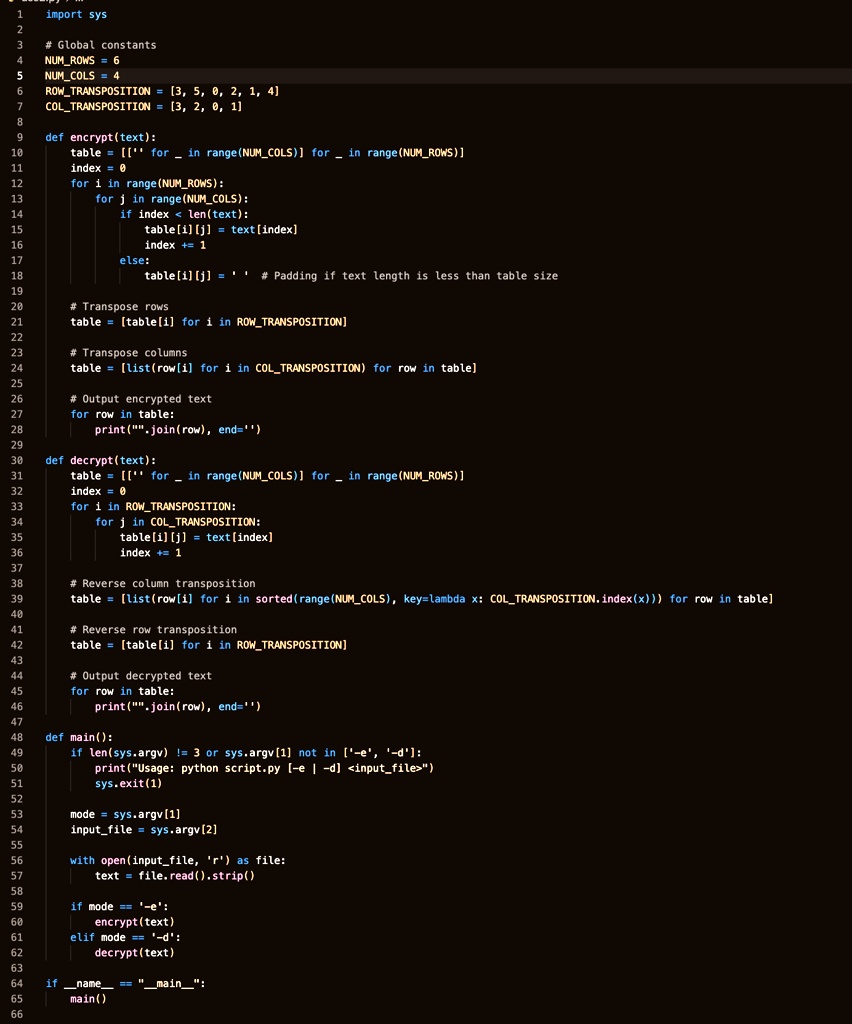
I have python code I need help with. When decrypting, it is just returning whatever I am inputting. It encrypts and decrypts by file input. Usage is "python script.py -e input.txt" for encryption and -d for decryption. It is a double transposition cipher, need help fixing it to where it outputs the proper decrypted message. Encryption works just fine. # Global constants NUM_ROWS = 6 NUM_COLS = 4 ROW_TRANSPOSITION = [3, 5, 0, 2, 1, 4] COL_TRANSPOSITION = [3, 2, 0, 1] def encrypt(text): table = [['' for _ in range(NUM_COLS)] for _ in range(NUM_ROWS)] index = 0 for i in range(NUM_ROWS): for j in range(NUM_COLS): if index < len(text): table[i][j] = text[index] index += 1 else: table[i][j] = ' ' # Padding if text length is less than table size # Transpose rows table = [table[i] for i in ROW_TRANSPOSITION] # Transpose columns table = [list(row[i] for i in COL_TRANSPOSITION) for row in table] # Output encrypted text for row in table: print("".join(row), end=' ') def decrypt(text): table = [['' for _ in range(NUM_COLS)] for _ in range(NUM_ROWS)] index = 0 for i in ROW_TRANSPOSITION: for j in COL_TRANSPOSITION: table[index] index += 1 # Reverse column transposition table = [list(row[i] for i in sorted(range(NUM_COLS), key=lambda x: COL_TRANSPOSITION.index(x))) for row in table] # Reverse row transposition table = [table[i] for i in ROW_TRANSPOSITION] # Output decrypted text for row in table: print("'.join(row), end=' ') def main(): if len(sys.argv) != 3 or sys.argv[1] not in ['-e', '-d']: print("Usage: python script.py [-e | -d]") import sys # Global constants NUM_ROWS = 6 NUM_COLS = 4 ROW_TRANSPOSITION = [3, 5, 0, 2] COL_TRANSPOSITION = [3, 2, 0, 1] def encrypt(text): for in range(NUM_COLS)] for in range(NUM_ROWS)] index = for i in range(NUM_ROWS): for j in range(NUM_COLS): if index < len(text): table[i][j] = text[index] index += 1 else: table[i][j] # Padding if text length is less than table size # Transpose rows table = [table[i] for i in ROW_TRANSPOSITION] # Transpose columns table = [list(row[i] for i in COL_TRANSPOSITION) for row in table] # Output encrypted text for row in table: print("".join(row), end=' ') def decrypt(text): table = [['' for in range(NUM_COLS)] for in range(NUM_ROWS)] index = for 1 in ROW_TRANSPOSITION: for j in COL_TRANSPOSITION: table[i][j] = text[index] index += 1 # Reverse column transposition table = [list(row[i] for i in sorted(range(NUM_COLS), key=lambda x: COL_TRANSPOSITION.index(x))) for row in table] # Reverse row transposition table = [table[i] for i in ROW_TRANSPOSITION] # Output decrypted text for row in table: print("'.join(row), end=' ') def main: if len(sys.argv) != 3 or sys.argv[1] not in ['-e', :[.p- print("Usage: python script.py [-e | -d] <input_file>") sys.exit(1) mode = sys.argv[1] input_file = sys.argv[2] with open(input_file, 'r') as file: text = file.read().strip() if mode == '-e': encrypt(text) elif mode == '-d': decrypt(text) if __name == 'main': main()
View Answer
divider
BEST MATCH

In a complex task such as creating a website for learning, instructors may want to support the generation of multiple solutions in learners' peer feedback. Anonymity may create a social context where learners feel freer to express varied ideas, and make the task of giving feedback less inhibited. However, teachers need to know just how anonymity impacts the learning dynamic in order to make informed choices about when anonymous configurations are appropriate in peer feedback. References: Howard, C. D., Barrett, A. F., & Frick, T. W. (2010). Anonymity to promote peer feedback: Pre-service teachers' comments in asynchronous computer-mediated communication. Journal of Educational Computing Research, 43(1), 89-112. According to Howard, Barrett, and Frick (2010), in order to make appropriate choices educators must understand the ways in which hiding or showing the identity of participants can impact the interaction that takes place in peer feedback activities. Obscuring the identity of participants in peer feedback "may create a social context where learners feel freer to express varied ideas, and make the task of giving feedback less inhibited" (p. 90). References: Howard, C. D., Barrett, A. F., & Frick, T. W. (2010). Anonymity to promote peer feedback: Pre-service teachers' comments in asynchronous computer-mediated communication. Journal of Educational Computing Research, 43(1), 89-112. Which of the following is true for the Student Version above? Word-for-Word plagiarism Paraphrasing plagiarism This is not plagiarism

View Answer
divider
BEST MATCH

Gender identity refers to the perception other people have regarding an individual's gender True False

View Answer
divider
BEST MATCH

(5) The state education department is considering introducing new initiatives to boost the reading levels of fourth graders. The mean reading level of fourth graders in the state over the last 5 years was a Lexile reader measure of 800 L. (A Lexile reader measure is a measure of the complexity of the language that a reader is able to comprehend.) The developers of a new program claim that their techniques will raise the mean reading level of fourth graders by more than 50 L. To assess the impact of their initiative, the developers were given permission to implement their ideas in the classrooms. At the end of the pilot study, a simple random sample of 1000 fourth graders had a mean reading level of 856 L. It is assumed that the population standard deviation is 98 L. Using a 0.05 level of significance, should the findings of the study convince the education department of the validity of the developers' claim? Use the rejection region method. (6) Nurses in a large teaching hospital have complained for many years that they are overworked and understaffed. The consensus among the nursing staff is that the mean number of patients per nurse each shift is at least 8.0. The hospital administrators claim that the mean is lower than 8.0. In order to prove their point to the nursing staff, the administrators gather information from a simple random sample of 19 nurses' shifts. The sample mean is 7.5 patients per nurse with a standard deviation of 1.1 patients per nurse. Test the administrators' claim using ? = 0.025, and assume that the number of patients per nurse has a normal distribution. (7) According to a report published by the Mathematical Association of America, 1% of bachelor's degrees in the United States are awarded in the fields of mathematics and statistics. One recent mathematics graduate believes that this number is incorrect. She has no indication if the actual percentage is more or less than 1%. To perform a hypothesis test, she uses a simple random sample of 12,317 recent college graduates for her sample. According to the graduation programs from the colleges, she notes that bachelor's degrees in mathematics or statistics were awarded to 148 graduates in her sample. Does this evidence support this graduate's belief that the percentage of bachelor's degrees awarded in the fields of mathematics and statistics is not 1%? Use a 0.10 level of significance.

View Answer
divider
BEST MATCH

Banking was often in the hands of Jews who looked after rich people's money. Who replaced the Jews? Italian immigrant bankers from Lombardy Roman immigrants bankers from Rome Goldsmith immigrant bankers from Brussels French immigrant bankers from France

View Answer
divider
BEST MATCH

QUESTION 2 Winnie is investigating whether taller people make more money. She regresses income (dollars per year, the dependent variable) on height in centimeters (the independent variable) and gets a regression coefficient of 600. How can she interpret that result? All else equal, for every additional centimeter in height, we expect the person to make $600 more per year. The share of variation in the dependent variable, income, that can be explained by the independent variable, height, is 600. All else equal, for every additional dollar per year in annual salary, we expect the person to be 600 centimeters taller. The number 600 indicates a strong, positive relationship between height and income: the coefficient tells us that on a scatterplot, the points would be close to the trendline.

View Answer
divider