Texts:
3. Donating from the collaborative outcome.
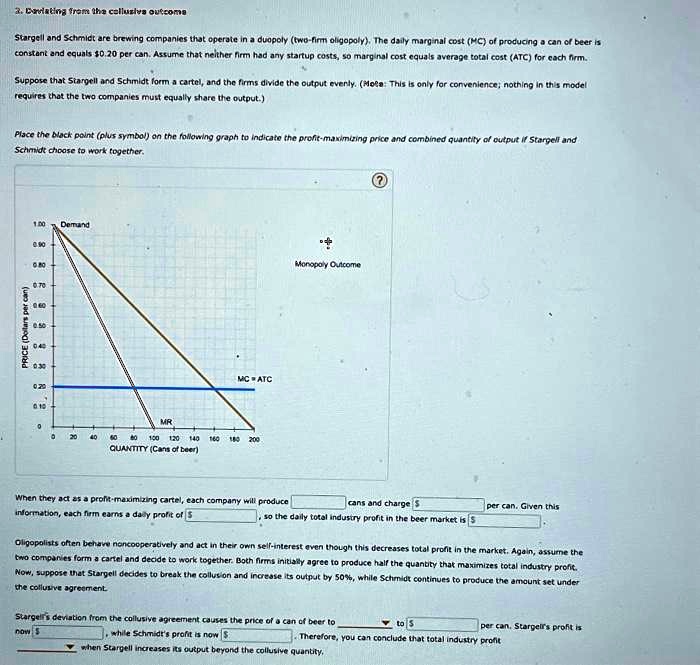
Stargell and Schmidt are brewing companies that operate in a duopoly, a two-firm oligopoly. The daily marginal cost (MC) of producing a can of beer is constant and equals 0.20 per can. Assume that neither firm had any startup costs, so marginal cost equals average total cost (ATC) for each firm. Suppose that Stargell and Schmidt form a cartel, and the firms divide the output evenly. (Note: This is only for convenience; nothing in this model requires that the two companies must equally share the output.)
Schmidt chooses to work together.
Monopoly Outcome
0.80
0.70
0.40
0.30
0.20
0.10
MR
100
120
140
QUANTITY (Cans of beer)
When they act as a profit-maximizing cartel, each company will produce cans and charge per can. Given this information, each firm earns a daily profit of S, so the daily total industry profit in the beer market is S.
Oligopolists often behave when two companies form a cartel and decide to work together. Both firms initially agree to produce half the quantity that maximizes total industry profit, the collusive agreement.
Stargell's deviation from the collusive agreement causes the price of a can of beer to rise to 5 now per can. Stargell's profit is hle Schmict's profit is nomS. Therefore, you can conclude that total industry profit decreases when Stargell increases its output beyond the collusive quantity.