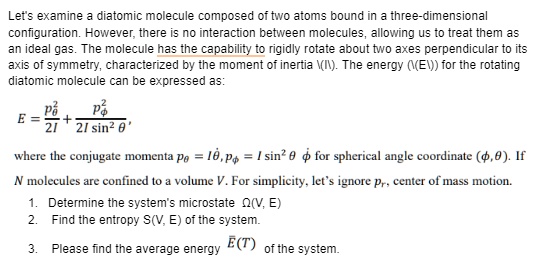
Let's examine a diatomic molecule composed of two atoms bound in a three-dimensional\nconfiguration. However, there is no interaction between molecules, allowing us to treat them as\nan ideal gas. The molecule has the capability to rigidly rotate about two axes perpendicular to its\naxis of symmetry, characterized by the moment of inertia \(I\). The energy \(E\) for the rotating\ndiatomic molecule can be expressed as:\n\(E = \frac{p_\theta^2}{2I} + \frac{p_\phi^2}{2I \sin^2 \theta}\),\nwhere the conjugate momenta \(p_\theta = I \dot{\theta}\), \(p_\phi = I \sin^2 \theta \dot{\phi}\) for spherical angle coordinate \((\phi, \theta)\). If\n\(N\) molecules are confined to a volume \(V\). For simplicity, let's ignore \(p_r\), center of mass motion.\n1. Determine the system's microstate \(\Omega(V, E)\)\n2. Find the entropy \(S(V, E)\) of the system.\n3. Please find the average energy \(\bar{E}(T)\) of the system.