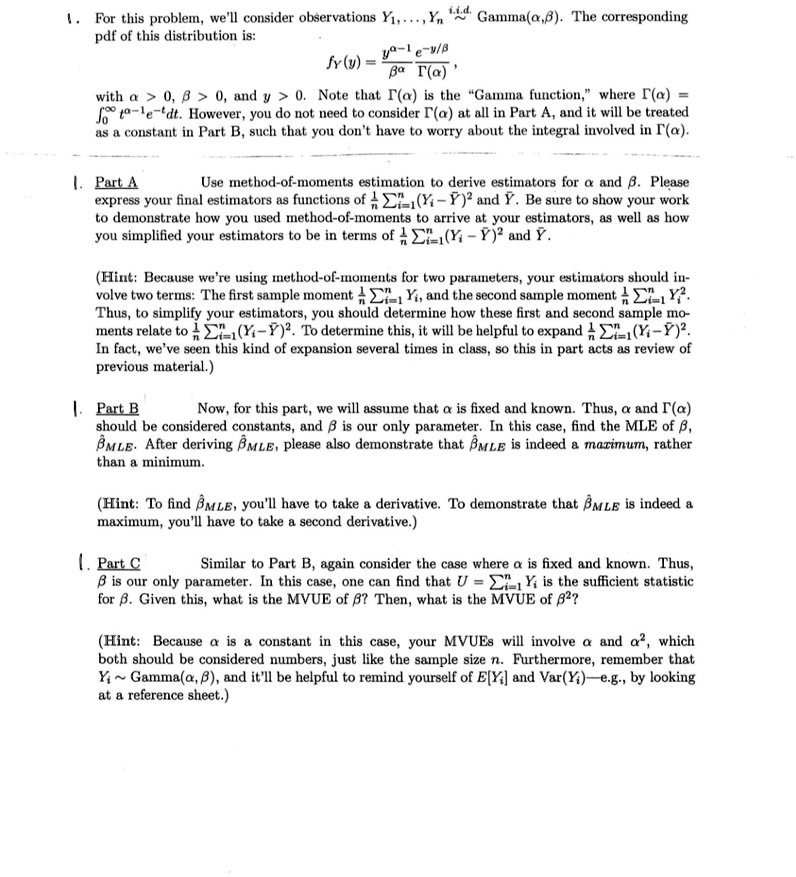
Part A
Use method-of-moments estimation to derive estimators for α and β. Please express your final estimators as functions of (1/n)∑(i=1)^n (Yi-Ȳ)^2 and Ȳ. Be sure to show your work to demonstrate how you used method-of-moments to arrive at your estimators, as well as how you simplified your estimators to be in terms of (1/n)∑(i=1)^n (Yi-Ȳ)^2 and Ȳ.
(Hint: Because we're using method-of-moments for two parameters, your estimators should involve two terms: The first sample moment (1/n)∑(i=1)^n Yi, and the second sample moment (1/n)∑(i=1)^n Yi^2. Thus, to simplify your estimators, you should determine how these first and second sample moments relate to (1/n)∑(i=1)^n (Yi-Ȳ)^2. To determine this, it will be helpful to expand (1/n)∑(i=1)^n (Yi-Ȳ)^2. In fact, we've seen this kind of expansion several times in class, so this in part acts as review of previous material.)
Part B
Now, for this part, we will assume that α is fixed and known. Thus, α and Γ(α) should be considered constants, and β is our only parameter. In this case, find the MLE of β, hat(β)_MLE. After deriving hat(β)_MLE, please also demonstrate that hat(β)_MLE is indeed a maximum, rather than a minimum.
(Hint: To find hat(β)_MLE, you'll have to take a derivative. To demonstrate that hat(β)_MLE is indeed a maximum, you'll have to take a second derivative.)
Part C
Similar to Part B, again consider the case where α is fixed and known. Thus, β is our only parameter. In this case, one can find that U=∑(i=1)^n Yi is the sufficient statistic for β. Given this, what is the MVUE of β? Then, what is the MVUE of β^2?
(Hint: Because α is a constant in this case, your MVUEs will involve α and α^2, which both should be considered numbers, just like the sample size n. Furthermore, remember that Yi~Gamma(α, β), and it'll be helpful to remind yourself of E[Yi] and Var(Yi) - e.g., by looking at a reference sheet.)