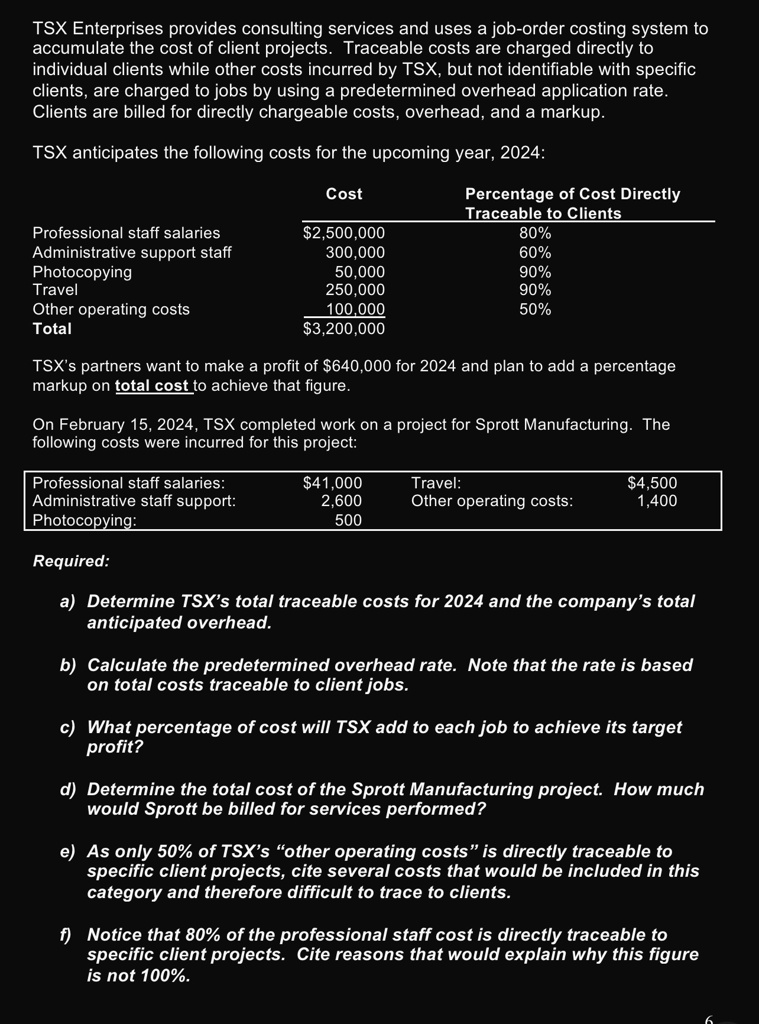
TSX Enterprises provides consulting services and uses a job-order costing system to accumulate the cost of client projects. Traceable costs are charged directly to individual clients while other costs incurred by TSX, but not identifiable with specific clients, are charged to jobs by using a predetermined overhead application rate. Clients are billed for directly chargeable costs, overhead, and a markup.
TSX anticipates the following costs for the upcoming year, 2024:
- Professional staff salaries: $2,500,000 (80% directly traceable to clients)
- Administrative support staff: $300,000 (60% directly traceable to clients)
- Photocopying: $50,000 (90% directly traceable to clients)
- Travel: $250,000 (90% directly traceable to clients)
- Other operating costs: $100,000 (50% directly traceable to clients)
Total: $3,200,000
TSX's partners want to make a profit of $640,000 for 2024 and plan to add a percentage markup on total cost to achieve that figure.
On February 15, 2024, TSX completed work on a project for Sprott Manufacturing. The following costs were incurred for this project:
- Professional staff salaries: $41,000
- Administrative staff support: $2,600
- Photocopying: $500
- Travel: $4,500
- Other operating costs: $1,400
Required:
a) Determine TSX's total traceable costs for 2024 and the company's total anticipated overhead.
b) Calculate the predetermined overhead rate. Note that the rate is based on total costs traceable to client jobs.
c) What percentage of cost will TSX add to each job to achieve its target profit?
d) Determine the total cost of the Sprott Manufacturing project. How much would Sprott be billed for services performed?
e) As only 50% of TSX's "other operating costs" is directly traceable to specific client projects, cite several costs that would be included in this category and therefore difficult to trace to clients. Notice that 80% of the professional staff cost is directly traceable to specific client projects. Cite reasons that would explain why this figure is not 100%.