Ace - AI Tutor
Ask Our Educators
Textbooks
My Library
Flashcards
Scribe - AI Notes
Notes & Exams
Download App
garrett moon

garrett m.

Divider

Questions asked

BEST MATCH

Question 5 (2 points) Saved The effect of wolves on elk in Yellowstone is an example of __________. A) a top-down interaction B) Poisson distribution C) a bottom-up interaction D) trophism

View Answer
divider
BEST MATCH

When a debtor makes a payment to a creditor specifying how it should be applied the creditor must apply the payment

View Answer
divider
BEST MATCH

Mr. Carter will retire next month. He has slowly been removing his mark from the company, as well as lessening his interest and activity in his community. This is an example of the pattern predicted by which theory of aging?

View Answer
divider
BEST MATCH

find the reduced form and the inverse form of each of the following words a. a^2b^-1

View Answer
divider
BEST MATCH

Singer believes that in order to deserve some degree of moral consideration, a being must be: A Capable of defending its right to be given moral consideration B A fully developed adult C Capable of discourse (learning and speaking a language) D Sentient E Intelligent

View Answer
divider
BEST MATCH

The nurse is performing the third check of medication administration with the client and notes the birthdate in the electronic health record and the birthdate on the medication label do not match. What action should the nurse take next? Answers: A- Di A Hold the medication.. B Contact the pharmacy. Notify the charge nurse. Continue client identification.

View Answer
divider
BEST MATCH

Which of the following is not a tool for measuring body composition? Multiple Choice Skinfolds Bioelectrical impedance Body mass index Underwater weighing

View Answer
divider
BEST MATCH

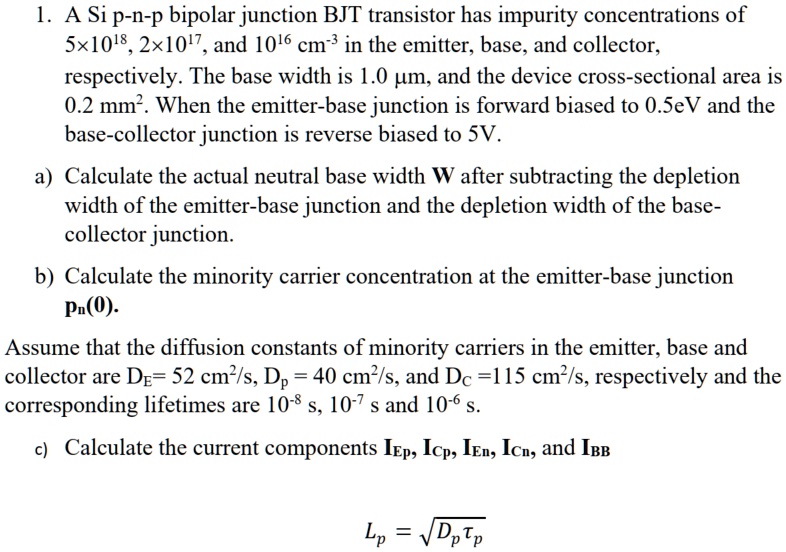
1. A Si p-n-p bipolar junction BJT transistor has impurity concentrations of 5×10$^{18}$, 2×10$^{17}$, and 10$^{16}$ cm$^{-3}$ in the emitter, base, and collector, respectively. The base width is 1.0 µm, and the device cross-sectional area is 0.2 mm$^2$. When the emitter-base junction is forward biased to 0.5eV and the base-collector junction is reverse biased to 5V. a) Calculate the actual neutral base width $W$ after subtracting the depletion width of the emitter-base junction and the depletion width of the base- collector junction. b) Calculate the minority carrier concentration at the emitter-base junction $P_n(0)$. Assume that the diffusion constants of minority carriers in the emitter, base and collector are $D_E$= 52 cm$^2$/s, $D_P$ = 40 cm$^2$/s, and $D_C$ =115 cm$^2$/s, respectively and the corresponding lifetimes are 10$^{-8}$ s, 10$^{-7}$ s and 10$^{-6}$ s. c) Calculate the current components $I_{EP}$, $I_{CP}$, $I_{EN}$, $I_{CN}$, and $I_{BB}$ $L_P = \sqrt{D_P\tau_P}$
View Answer
divider
BEST MATCH

IBC3012: Information & Coding for Communications 1. The symbols am of an alphabet A = {ao, ai, .... an-1} occur with probability pm. a) What is the cardinality of the alphabet? [1] b) Define the Shannon entropy, H, of the source. Under what circumstances is the entropy (i) a maximum and (ii) a minimum? [4] c) State Shannon's noiseless coding theorem. [3] d) Explain a procedure that enables one to come arbitrarily close to the promise made in this theorem. [9] e) For the channel code in Table 1, determine its minimum distance, how many bit errors can it detect, and how many bit errors can it correct. If the word 011110 is received at the channel output, try to decide which message should be decoded into. Explain with possible scenarios of detection and correction. Message L = 3 Code word N = 6 000 000000 100 011100 010 101010 110 110110 101 100011 101 101101 111 110110 111000 Table 1 [6] f) Calculate the mutual information I(A;B) = H(B) - H(B|A) for the BSC channel with p = 0.5. Assume the input P(A) = {0.2, 0.8}. Explain what you can conclude from the result. [5]

View Answer
divider
BEST MATCH

The mean energy \(\epsilon\) is related to Z by \(\langle\epsilon\rangle = kT^2 \frac{\partial \ln Z}{\partial T}\). i. Show that the mean energy of a harmonic oscillator is given by $\langle\epsilon\rangle = \frac{h\nu}{2} + \frac{h\nu}{\left(e^{\frac{h\nu}{kT}} - 1\right)}.$ ii. What is the mean energy in the low-temperature limit? What does this correspond to physically? iii. What is the mean energy in the high-temperature limit? How does this compare with the classical prediction?

View Answer
divider