Texts: Please provide detailed solutions for each question below. This is for an undergraduate physical cosmology course.
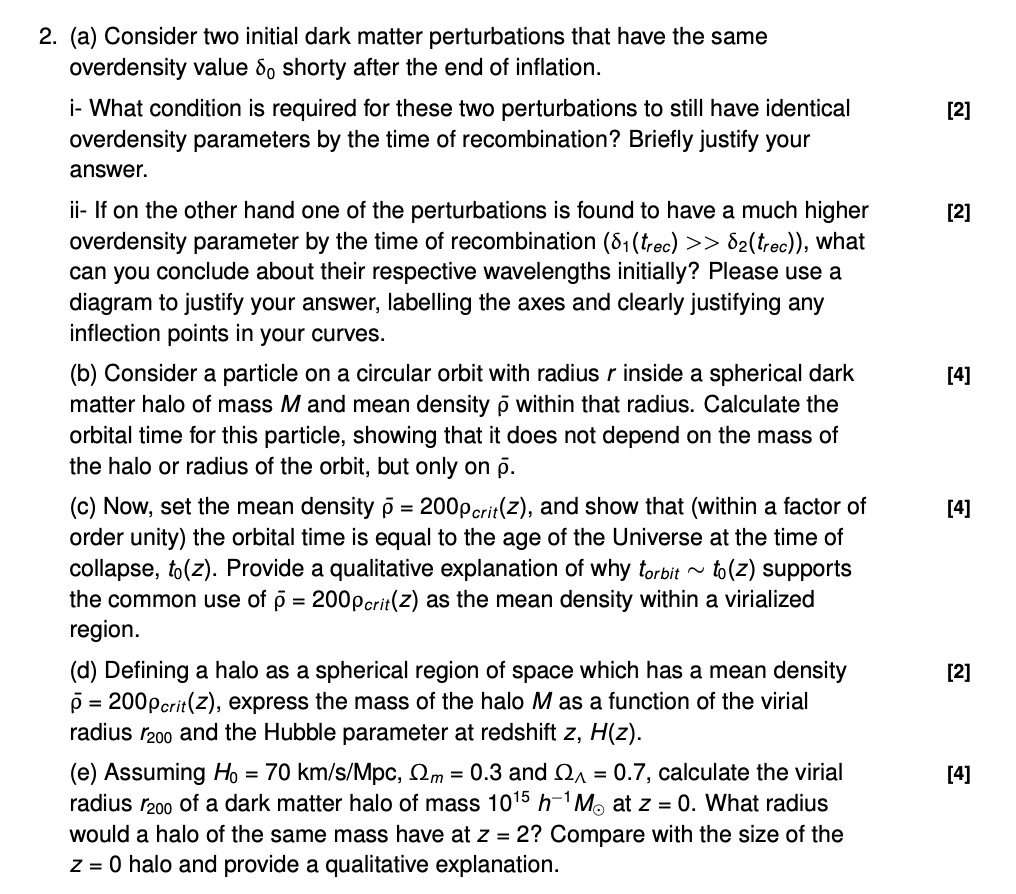
2. (a) Consider two initial dark matter perturbations that have the same overdensity value shortly after the end of inflation.
i- What condition is required for these two perturbations to still have identical overdensity parameters by the time of recombination? Briefly justify your answer.
[2]
ii- If, on the other hand, one of the perturbations is found to have a much higher overdensity parameter by the time of recombination (t_rec >> 2t_rec), what can you conclude about their respective wavelengths initially? Please use a diagram to justify your answer, labeling the axes and clearly justifying any inflection points in your curves.
[2]
(b) Consider a particle on a circular orbit with radius r inside a spherical dark matter halo of mass M and mean density p within that radius. Calculate the orbital time for this particle, showing that it does not depend on the mass of the halo or radius of the orbit, but only on p.
[4]
(c) Now, set the mean density p = 200pcrit(z), and show that (within a factor of order unity) the orbital time is equal to the age of the Universe at the time of collapse, to(z). Provide a qualitative explanation of why torbit ~ to(z) supports the common use of p = 200pcrit(z) as the mean density within a virialized region.
[4]
(d) Defining a halo as a spherical region of space which has a mean density p = 200pcrit(z), express the mass of the halo M as a function of the virial radius r_200 and the Hubble parameter at redshift z, H(z).
[2]
(e) Assuming Ho = 70 km/s/Mpc, Qm = 0.3, and Q = 0.7, calculate the virial radius r_200 of a dark matter halo of mass 10^15 h^-1 Mo at z = 0. What radius would a halo of the same mass have at z = 2? Compare with the size of the z = 0 halo and provide a qualitative explanation.