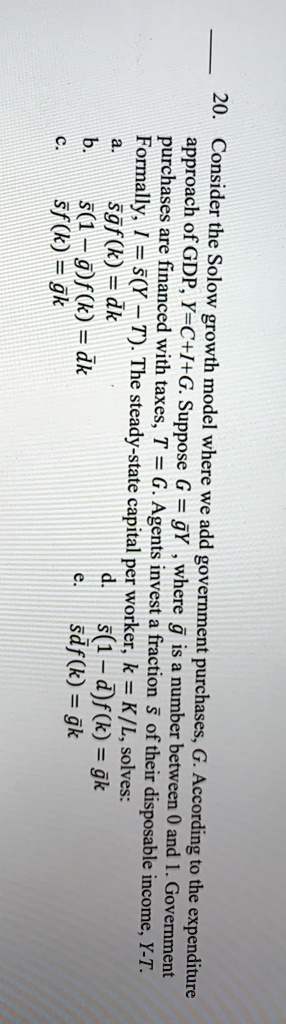
20. Consider the Solow growth model where we add government purchases, G. According to the expenditure approach of GDP, $Y = C + I + G$. Suppose $G = \bar{g}Y$, where $\bar{g}$ is a number between 0 and 1. Government purchases are financed with taxes, $T = G$. Agents invest a fraction $s$ of their disposable income, $Y - T$. Formally, $I = s(Y - T)$. The steady-state capital per worker, $k = K/L$, solves:
a. $s\bar{g}f(k) = \bar{g}k$
b. $s(1 - \bar{g})f(k) = \bar{g}k$
c. $sf(k) = \bar{g}k$
d. $s(1 - \bar{g})f(k) = \bar{g}k$
e. $sdf(k) = \bar{g}k$