Ace - AI Tutor
Ask Our Educators
Textbooks
My Library
Flashcards
Scribe - AI Notes
Notes & Exams
Download App
gary james

gary j.

Divider

Questions asked

BEST MATCH

Assume that Congress is considering several new tax provisions to encourage savings. Each of the proposed structures allows an individual to invest up to $18,000 of annual earnings in a savings plan which allows no current deduction. Which structure employs the time period variable to provide a tax incentive to save? Multiple choice question. The savings plan allows for investment in government funds that guarantee a minimum return which increases the longer the funds are invested. The annual earnings invested and income generated from that investment will not be taxed until the funds are withdrawn upon retirement. The earnings invested and the income generated from that investment will be taxed when earned at a lower, preferential rate.

View Answer
divider
BEST MATCH

Find the average value of F(x, y, z) = z over the region bounded below by the xy-plane, on the sides by the sphere x2 + y2 + z2 = 64, and bounded above by the cone 𝜑 = 𝜋3 . 92

View Answer
divider
BEST MATCH

Hello can anybody help me discussing The importance of feature engineering in improving classification accuracy with examples

View Answer
divider
BEST MATCH

Suppose that Barry’s, who produces baseball in a competitive market, faces the following costs in short-run If the firm produces 4 units of output, what is the marginal cost? What is the average variable cost? What is the average total cost? b. [2 marks] If the price P=$3.50 per baseball, what is Barry’s optimal level of production? What criteria did you use to determine the optimal level of production? c. [2 marks] If the price if P=$7.50 per baseball, what is Barry’s optimal level of production? What criteria did you use to determine the optimal level of production? d. [2 marks] If the price if P=$7.50 per baseball, how much is the profit? Explain firm’s production behavior under this profit

View Answer
divider
BEST MATCH

In detail, explain the difference between Hodgkin's Lymphoma and non-Hodgkin's Lymphoma.

View Answer
divider
BEST MATCH

The income statement for Asia's Company for 2010 is as below: Asia Company for knitting winter clothes Income Statement Year ended December, 31 2010 Sales (50,000 units at $30 each) Variable Cost (50,000 at $20) Contribution Margin Fixed Cost EBIT (Operating Profit) Given this income statement: a) Compute the Break-even points b) Compute the contribution margin rate c) Using the contribution margin rate, what is the Break-even in dollar d) Find the sales (in units &dollars) needed to earn a profit of $25,000. e) Compute the Degree of Operating Leverage. f) Compute the impact of 20% increase in sales on operating leverage. $1,500,000 ($1000,000) $500,000 ($350,000) $150,000

View Answer
divider
BEST MATCH

(14) Stoichiometry Review. Determine the mass of each of the following: (a) 0.0146 mol KOH (b) 10.2 mol ethane, $C_2H_6$ (c) $6.854 \times 10^3$ mol glucose, $C_6H_{12}O_6$ (d) 2.86 mol $Co(NH_3)_6Cl_3$

View Answer
divider
BEST MATCH

Miniproject1 Problem 2 MATLAB Grader ENG 006 A01-A11 WQ 2024 Complete the function MiniProject1. For a given array of numbers, return the numbers within the range -2 <= x < 6, and also return the positions of the selected numbers within the array. The input argument \textbullet arrayNumbers: is a 1D double-precision row array. The output arguments: \textbullet numbers: a 1D row array containing the numbers within the range -2 <= x < 6. \textbullet indices: a 1D row array containing the positions of the selected values used to produce the numbers output array. Restrictions: The solution must use logical indexing. Do not use loops or if else statements. Hints: As loops cannot be used, use the internal function size on the input array (arrayNumbers), and use logical indexing to find the location of the identified numbers in the input array. To find the positions you could create an array of integers from 1 to the numbers of elements in the input array. Then, apply the logical indexing array on this array. Example Inputs: arrayNumbers = -2 8 1 9 3 3 9 calling the function: [numbers, indexes] = FindNumbers(arrayNumbers) 1x4 double Qutputs: numbers -2 1 3 3 indices 1x4 double 1 3 5 6 The array indices indicates that the -2 was in the 1st Position, the 1 was in the 3rd Position, and the 3's were in the 5th and 6th positions. Note: Problem1 and Problem2 are combined into completing the function MiniProject1 which combines the inputs and outputs of both problems instead of implementing two separate functions.

View Answer
divider
BEST MATCH

Problem 1 [Total 7 points] Consider a 1<sup>st</sup>-order ordinary differential equation (ODE), $M(x, y)dx + N(x, y)dy = 0$ where $M(x, y) = 4x + 3y^2$ and $N(x, y) = 2xy$. An initial condition is given as $y(1) = 2$. [1.1-2 points] Show that the given ODE is NOT exact. [1.2-1 point] Apply the integrating factor $F(x)$ to the ODE and show that the new equation is exact. $F(x) = x^2$ [1.3-3 points] With the integrating factor $F(x)$ from [1.2], find the general solution of the given ODE. [1.4-1 point] Applying the initial condition, obtain the final solution.

View Answer
divider
BEST MATCH

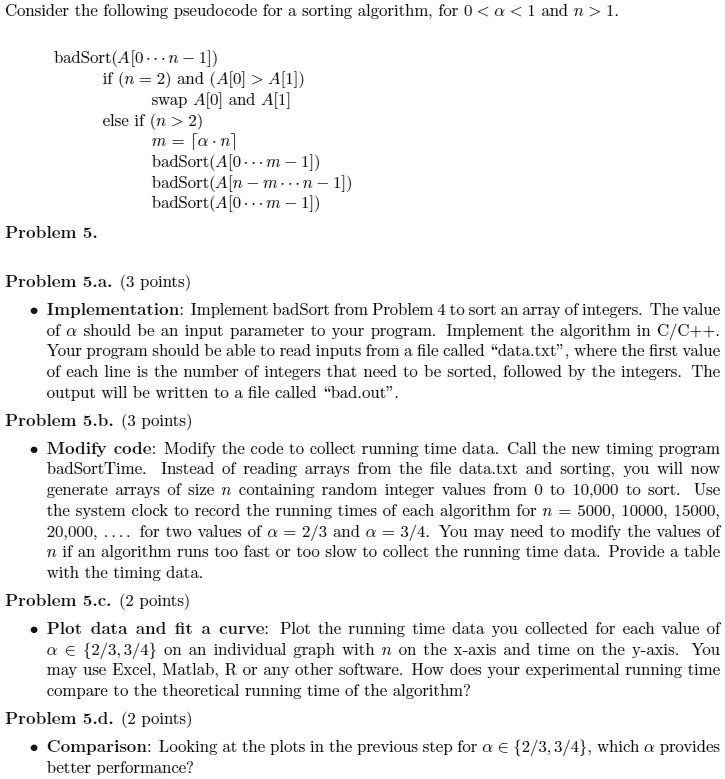
Please code in Python. I'll upload for a completed response. Thanks. This is the completed information. data.txt file could be just a single line of integers. Consider the following pseudocode for a sorting algorithm, for 0 < n < 1 and n > 1. badSort(A[0...n-1]): if n = 2 and A[0] > A[1]: swap A[0] and A[1] else if n > 2: m = [an] badSort(A[0...m-1]) badSort(A[n-m...n-1]) badSort(A[0...m-1]) Problem 5. Problem 5.a. (3 points) Implementation: Implement badSort from Problem 4 to sort an array of integers. The value of n should be an input parameter to your program. Implement the algorithm in C/C++. Your program should be able to read inputs from a file called data.txt where the first value of each line is the number of integers that need to be sorted, followed by the integers. The output will be written to a file called "bad.out". Problem 5.b. (3 points) Modify code: Modify the code to collect running time data. Call the new timing program badSortTime. Instead of reading arrays from the file data.txt and sorting, you will now generate arrays of size n containing random integer values from 0 to 10,000 to sort. Use the system clock to record the running times of each algorithm for n = 5000, 10000, 15000, 20000, ... for two values of n = 2/3 and n = 3/4. You may need to modify the values of n if an algorithm runs too fast or too slow to collect the running time data. Provide a table with the timing data. Problem 5.c. (2 points) Plot data and fit a curve: Plot the running time data you collected for each value of n {2/3, 3/4} on an individual graph with n on the x-axis and time on the y-axis. You may use Excel, Matlab, R or any other software. How does your experimental running time compare to the theoretical running time of the algorithm? Problem 5.d. (2 points) Comparison: Looking at the plots in the previous step for n {2/3, 3/4}, which algorithm provides better performance?
View Answer
divider