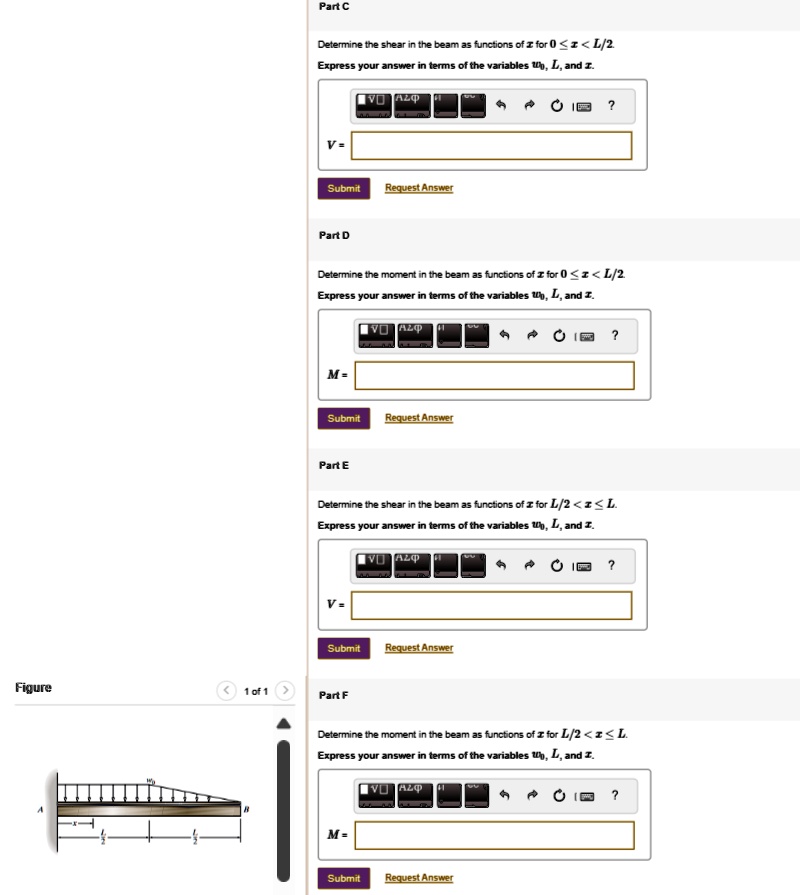
Consider the cantilever beam shown in (Figure 1). Part C
Determine the shear in the beam as functions of x for w_(0), LxV = xw_(0), LxM = xw_(0), Lx_(.)V = xw_(0), Lx_(.)M = (L)/(2).
Express your answer in terms of the variables w_(0), L, and x.
M = (L)/(2).
Express your answer in terms of the variables w_(0), L, and x.
Figure 1 of 1
V =
Part F
Determine the moment in the beam as functions of x for (L)/(2).
Express your answer in terms of the variables w_(0), L, and x.
M = 0 <= x.
Express your answer in terms of the variables w_(0), L, and x.
M =
Part E
Determine the shear in the beam as functions of x for (L)/(2).
Express your answer in terms of the variables w_(0), L, and x.
Figure 1 of 1
V =
Part F
Determine the moment in the beam as functions of x for (L)/(2).
Express your answer in terms of the variables w_(0), L, and x.
M = 0 <= x.
Express your answer in terms of the variables w_(0), L, and x.
V =
Part D
Determine the moment in the beam as functions of x for 0 <= x.
Express your answer in terms of the variables w_(0), L, and x.
M =
Part E
Determine the shear in the beam as functions of x for (L)/(2).
Express your answer in terms of the variables w_(0), L, and x.
Figure 1 of 1
V =
Part F
Determine the moment in the beam as functions of x for (L)/(2).
Express your answer in terms of the variables w_(0), L, and x.
M =
Part C
Determine the shear in the beam as functions of z for 0 < I/2
Express your answer in terms of the variables U, I, and
Submit
Request Answer
Part D
Determine the moment in the beam as functions of for 0 < < L/2
Express your answer in terms of the variables p, , and
M
Submit
Request Answer
Part E
Determine the shear in the beam as functions of for I/2 << I
Express your answer in terms of the variables , I, and z
Submit
Request Answer
Figure 1 of 1
Part F
Determine the moment in the beam as functions of for I/2 << I
Express your answer in terms of the variables p, , and C
M
Submit
Request Answer