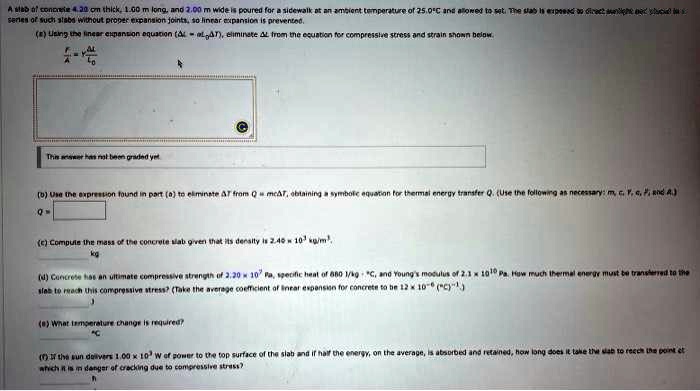
A slab of concrete 4.20 cm thick, 1.00 m long, and 2.00 m wide is poured for a sidewalk at an ambient temperature of 25.0°C and allowed to set. The slab is exposed to direct sunlight and because a series of such slabs without proper expansion joints, so linear expansion is prevented.
(a) Using the linear expansion equation ($\Delta L = \alpha L \Delta T$), eliminate $\Delta L$ from the equation for compressive stress and strain shown below.
\begin{equation*}
\frac{F}{A} = Y \frac{\Delta L}{L}
\end{equation*}
This answer has not been graded yet
(b) Use the expression found in part (a) to eliminate $\Delta T$ from $Q = mc\Delta T$, obtaining a symbolic equation for thermal energy transfer $Q$. (Use the following as necessary: $m$, $c$, $Y$, $\alpha$, $P$, and $A$.)
$Q = $
(c) Compute the mass of the concrete slab given that its density is $2.40 \times 10^3 \text{ kg/m}^3$.
kg
(d) Concrete has an ultimate compressive strength of $2.20 \times 10^7 \text{ Pa}$, specific heat of 880 J/kg °C, and Young's modulus of $2.3 \times 10^{10} \text{ Pa}$. How much thermal energy must be transferred to the slab to reach this compressive stress? (Take the average coefficient of linear expansion for concrete to be $12 \times 10^{-6} \text{ (°C)}^{-1}$.)
(e) What temperature change is required?
°C
(f) If the sun delivers $1.00 \times 10^3 \text{ W}$ of power to the top surface of the slab and if half the energy, on the average, is absorbed and retained, how long does it take the slab to reach the point at which it is in danger of cracking due to compressive stress?