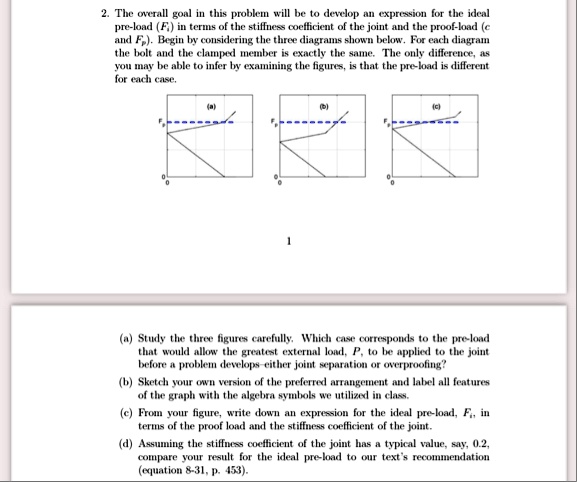
2. The overall goal in this problem will be to develop an expression for the ideal pre-load ($F_i$) in terms of the stiffness coefficient of the joint and the proof-load (c and $F_p$). Begin by considering the three diagrams shown below. For each diagram the bolt and the clamped member is exactly the same. The only difference, as you may be able to infer by examining the figures, is that the pre-load is different for each case.
(a) Study the three figures carefully. Which case corresponds to the pre-load that would allow the greatest external load, $P$, to be applied to the joint before a problem develops-either joint separation or overproofing?
(b) Sketch your own version of the preferred arrangement and label all features of the graph with the algebra symbols we utilized in class.
(c) From your figure, write down an expression for the ideal pre-load, $F_i$, in terms of the proof load and the stiffness coefficient of the joint.
(d) Assuming the stiffness coefficient of the joint has a typical value, say, 0.2, compare your result for the ideal pre-load to our text's recommendation (equation 8-31, p. 453).