Title: Two Year Costs and Hospitalization Rates for Training Recipients
Training
$18,277.19
Training
$20,819.96
Training
$18,656.11
Training
$27,509.90
Training
$25,364.61
Training
$30,384.52
Non-Training
$42,859.34
Non-Training
$24,224.94
Non-Training
$35,810.66
Non-Training
$37,286.74
Non-Training
$27,287.75
Non-Training
$44,699.91
Non-Training
$49,067.28
Non-Training
$28,724.30
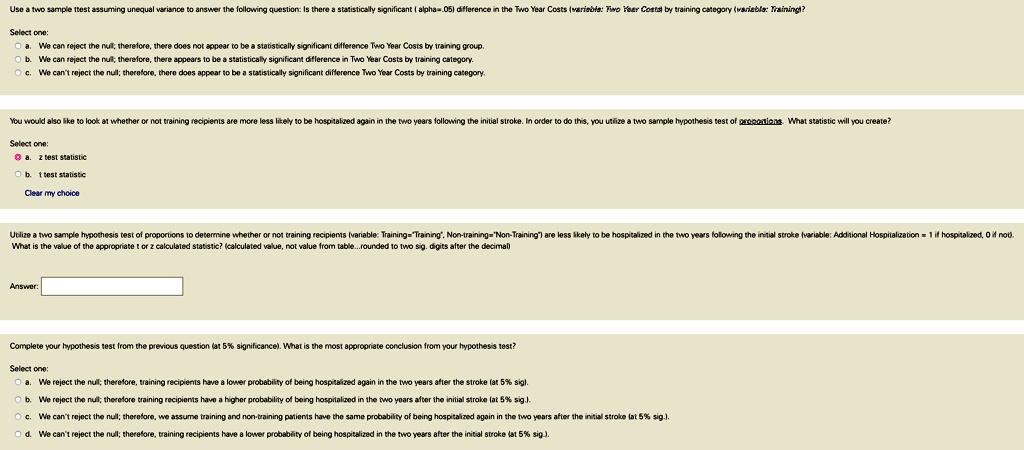
Select one: We can reject the null; therefore, there does not appear to be a statistically significant difference in Two Year Costs by training group.
We can't reject the null; therefore, there does appear to be a statistically significant difference in Two Year Costs by training category.
You would also like to look at whether or not training recipients are more or less likely to be hospitalized again in the two years following the initial stroke. In order to do this, you utilize a two-sample hypothesis test of proportions. What statistic will you create?
Select one: 8a
Ob t-test statistic
Clear my choice
Utilize a two-sample hypothesis test of proportions to determine whether or not training recipients (variable: Training=Training, Non-training=Non-Training) are less likely to be hospitalized in the two years following the initial stroke (variable: Additional Hospitalization = 1 if hospitalized, 0 if not). What is the value of the appropriate t or z calculated statistic? (calculated value, not value from table...rounded to two sig. digits after the decimal)
Answer:
Complete your hypothesis test from the previous question (at 5% significance). What is the most appropriate conclusion from your hypothesis test?
Select one: We reject the null; therefore, training recipients have a lower probability of being hospitalized again in the two years after the stroke (at 5% significance).
We reject the null; therefore, training recipients have a higher probability of being hospitalized in the two years after the initial stroke (at 5% significance).
We can't reject the null; therefore, we assume training and non-training patients have the same probability of being hospitalized again in the two years after the initial stroke (at 5% significance).
We can't reject the null; therefore, training recipients have a lower probability of being hospitalized in the two years after the initial stroke (at 5% significance).