Ace - AI Tutor
Ask Our Educators
Textbooks
My Library
Flashcards
Scribe - AI Notes
Notes & Exams
Download App
gema alexander

gema a.

Divider

Questions asked

BEST MATCH

Testosterone is apparently a very costly hormone for males to produce and use. Why, then, has natur selection rested in the males of some species investing in producing and using this hormone?. Because male animals share a common ancestor that used testosterone adaptively, and they continue to do so today Because testosterone helps ensure that males will be motivated to search for and to find all the receptive females oi tra speces. thereby benefitting their species as a whole. Because under a variety of circumstances, the hormone makes is possible for males to be either aggressive or senaly motivadi o ways that increase individual genetic success Because males that are able to pay the price for producing and using testosterone are demonstrating that they are able to overcume. this handicap, which means that they are genetically worthy members of the breeding stock for their population

View Answer
divider
BEST MATCH

Which population is expected to contribute most to the increased demand for healthcare services by 2025? Question 31 options: Children under 18 Working adults Aging population Immigrant population Veterans

View Answer
divider
BEST MATCH

Three uniform spheres are rolling without slipping. Sphere A has mass M and radius R. Sphere B has mass 2M and radius 2R. Sphere C has mass M and radius 2R. rsskaaren@alaska.edu 3A75-53-43-48-9F16-50197 Part (a) The spheres are placed at the top of an incline and released from rest. Which one is first to reach the bottom of the incline? Choose the best answer.

View Answer
divider
BEST MATCH

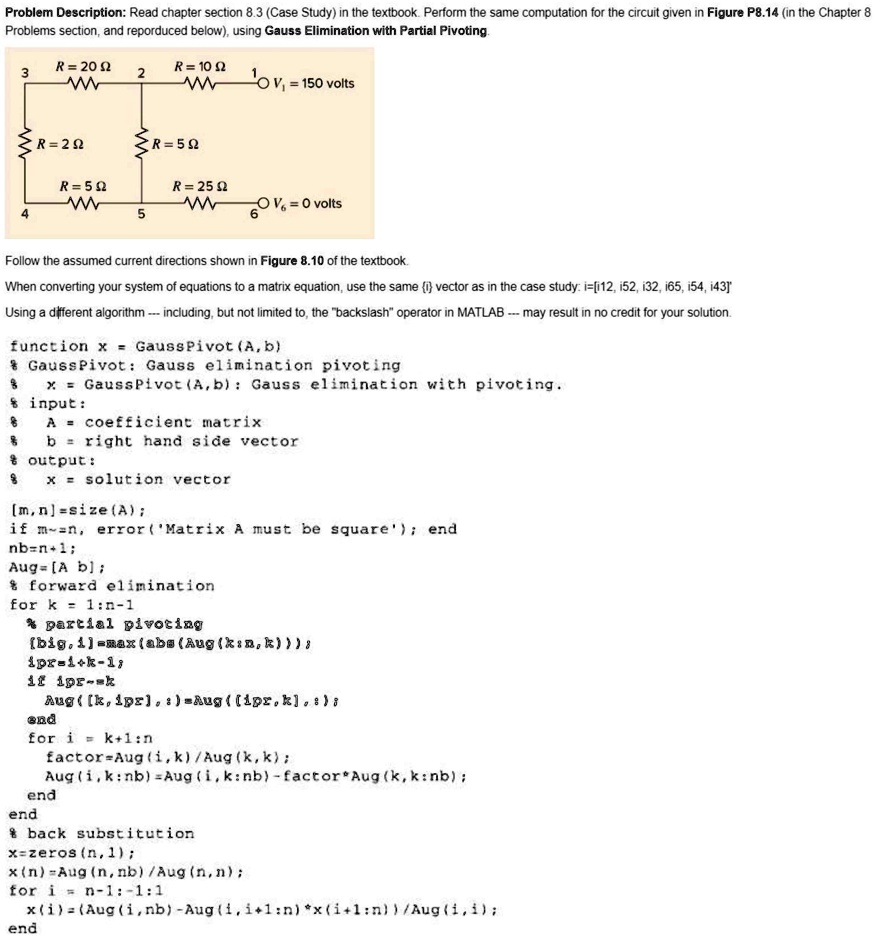
GOAL: SOLVE FOR THE 6 CURRENTS IN THE CIRCUIT. Problem Description: Read chapter section 8.3 (Case Study) in the textbook. Perform the same computation for the circuit given in Figure P8.14 (in the Chapter 8 Problems section, and reproduced below), using Gauss Elimination with Partial Pivoting. Follow the assumed current directions shown in Figure 8.10 of the textbook. When converting your system of equations to a matrix equation, use the same {i} vector as in the case study: i=[i12, i52, i32, i65, i54, i43] ' Using a different algorithm -.- including, but not limited to, the "backslash" operator in MATLAB - . may result in no credit for your solution. function x=GaussPi vot(A,b) of GaussPivot: Gauss elimination pivoting of x Gaussivot (A,b) : Gauss elimination with pivoting. & input: & A= coefficient matrix of b= right hand side vector output: s x= solution vector [m,n]=size(A); if m∼n, error('Matrix A must be square'); end nb=n+1; Aug =[[A,b]]; forward elimination for k=1:n-1 % partial pivoting [big,i]=max(abs(Aug(k:n,k))); ipr =i+k-1; if ipr ∼=k Aug([k,1pr],:)=Aug([ipr,k],:); end for i=k+1:n factor =Aug(i,k)/(A)ug(k,k); Aug(i,k:nb)=Aug(i,k:nb)-factor**Aug(k,k:nb); end end & back substitution x=zeros(n,1); x(n)=Aug(n,nb)/(A)ug(n,n); for i=n-1:-1:1 x(i)=(Aug(i,nb)-Aug(i,i+1:n)**x(i+1:n))/(A)ug(i,i); end Problem Description: Read chapter section 8.3(Case Study in the textbook. Perform the same computation for the circuit given in Figure P8.14 in the Chapter 8 Problems section, and reproduced below, using Gauss Elimination with Partial Pivoting. R=20 Ω 2 R=10 Ω OV=150 volts R=2 Ω R=5 Ω R=5 Ω R=25 Ω OV=0 volts Follow the assumed current directions shown in Figure 8.10 of the textbook. When converting your system of equations to a matrix equation, use the same {} vector as in the case study: i=[i12, i52, i32, i65, i54, i43] Using a different algorithm --- including, but not limited to, the "backslash" operator in MATLAB --- may result in no credit for your solution. function x = GaussPivot(A,b) GaussPivot: Gauss elimination pivoting x = GaussPivot(A,b): Gauss elimination with pivoting. input: A = coefficient matrix b = right hand side vector output: x = solution vector [m,n]=size(A); if m=n, error('Matrix A must be square'); end nb=n+1; Aug=[A,b]; % forward elimination for k=1:n-1 % partial pivoting [big,i]=max(abs(Aug(k:n,k)); ipr=i+k-1; if ipr=k Aug([k,ipr],:)=Aug([ipr,k],:); end for i=k+1:n factor=Aug(i,k)/Aug(k,k); Aug(i,k:nb)=Aug(i,k:nb)-factor*Aug(k,k:nb); end end % back substitution x=zeros(n,1); x(n)=Aug(n,nb)/Aug(n,n); for i=n-1:-1:1 x(i)=(Aug(i,nb)-Aug(i,i+1:n)*x(i+1:n))/Aug(i,i); end
View Answer
divider
BEST MATCH

4. (20 points) (20 points) Consider the simplistic model for killing cancer cells. A tissue consists of an n x n grid. The cancerous cells on the grid are given to you as input. To kill the cancerous cell you have a laser beam. You can select a row/ a column and pass a beam through it. This kills all the cancer cells in that particular row/column. However, hitting a row/a column with a laser beam is an immensely expensive procedure. 2 8 3 8 2 The blue cells are the cancer cells. Left is a suboptimal solution of cost 4. Right one is optimal with cost 3. Design an algorithm that outputs the minimum set of columns and rows such that if you hit these rows and columns with the laser beam then it kills all the cancerous cells in the tissue.

View Answer
divider
BEST MATCH

Al Hammond and Pat Conley appear to be killed instantly in the bomb blast on Luna. Group of answer choices True False

View Answer
divider
BEST MATCH

x(t) 1ms ... R=1k? ?=RC=0.5ms ->C=? Vc(t) C

View Answer
divider
BEST MATCH

A firm produces quantity Q of breakfast cereal using labour L and material M with the production function $Q = (ML)^2 + M + L$. (a) Find the marginal product functions for this production function. (6 marks) (b) What is the marginal rate of technical substitution of L for K for this production function? (5 marks) (c) What type of returns to scale arises from this production function? (6 marks) PART B Compare and contrast the short-run supply curve and the long run supply curve of the firm. Use appropriate diagrams to explain your answer. (8 marks) Total: [25 marks]

View Answer
divider
BEST MATCH

3.1 Consider two projects whose cash inflows are not even. Assume that the project costs R205,000. The net cash inflows for each year are as follows: Year Project X Project Y 1 R30,000.00 R75,000.00 2 R35,000.00 R95,000.00 3 R65,000.00 R60,000.00 4 R55,000.00 R26,000.00 5 R75,000.00 6 R95,000.00 REQUIRED 3.1.1 Calculate the payback period of each project and recommend the project that should be selected based on the payback period. (6 Marks)

View Answer
divider
BEST MATCH

Q1) Which one represents the bode magnitude and phase diagrams of the given transfer function $H(s) = s + \omega_n$ a) 90° 20 dB 45° $\omega_n$ $\omega_n$ 180° b) 20 dB 90° d) $\omega_n$ 90° 20 dB c) 45° 20 dB $\omega_n$ $\omega_n$ -20 dB -90° $\omega_n$ $\omega_n$ $\omega_n$

View Answer
divider