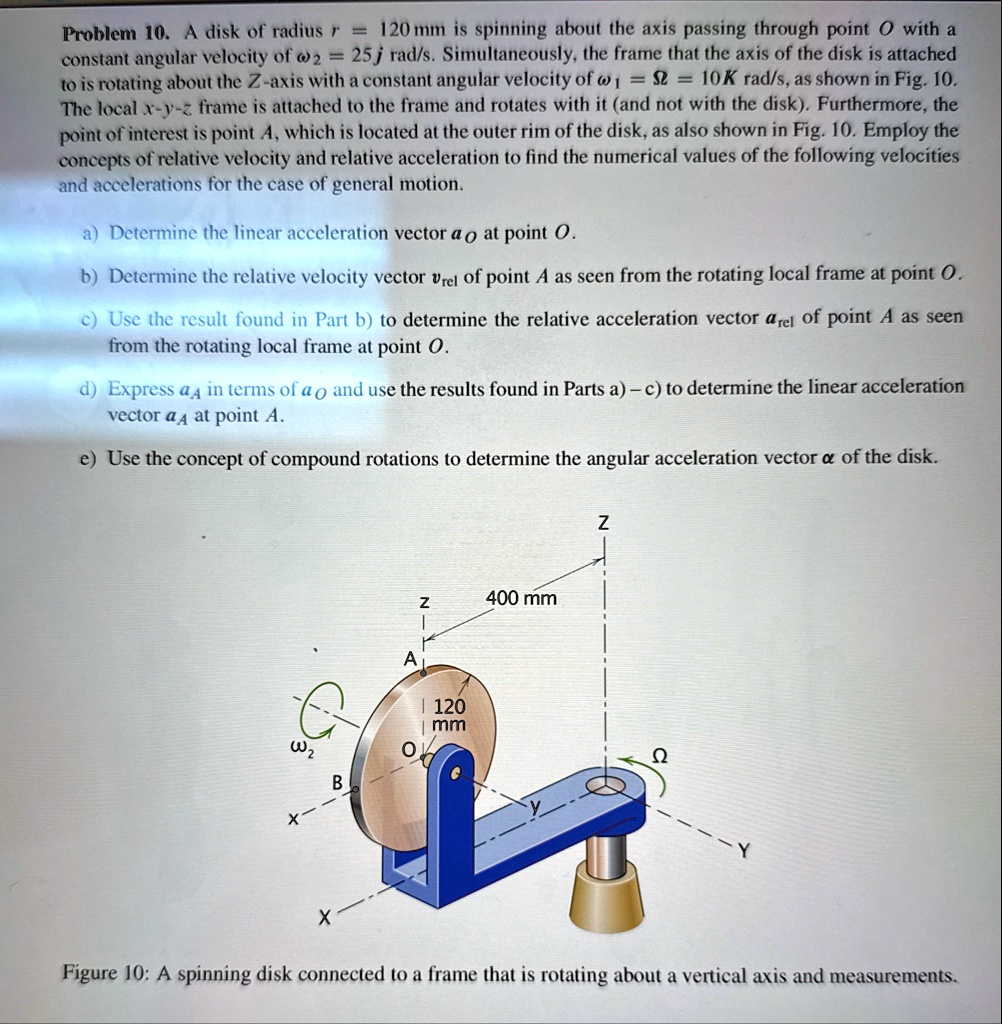
Problem 10. A disk of radius r = 120 mm is spinning about the axis passing through point O with a
constant angular velocity of $\omega_2$ = 25j rad/s. Simultaneously, the frame that the axis of the disk is attached
to is rotating about the Z-axis with a constant angular velocity of $\omega_1$ = $\Omega$ = 10K rad/s, as shown in Fig. 10.
The local x-y-z frame is attached to the frame and rotates with it (and not with the disk). Furthermore, the
point of interest is point A, which is located at the outer rim of the disk, as also shown in Fig. 10. Employ the
concepts of relative velocity and relative acceleration to find the numerical values of the following velocities
and accelerations for the case of general motion.
a) Determine the linear acceleration vector $a_O$ at point O.
b) Determine the relative velocity vector $v_{rel}$ of point A as seen from the rotating local frame at point O.
c) Use the result found in Part b) to determine the relative acceleration vector $a_{rel}$ of point A as seen
from the rotating local frame at point O.
d) Express $a_A$ in terms of $a_O$ and use the results found in Parts a) - c) to determine the linear acceleration
vector $a_A$ at point A.
e) Use the concept of compound rotations to determine the angular acceleration vector $\alpha$ of the disk.
Figure 10: A spinning disk connected to a frame that is rotating about a vertical axis and measurements.