Ace - AI Tutor
Ask Our Educators
Textbooks
My Library
Flashcards
Scribe - AI Notes
Notes & Exams
Download App
Gemayrole A

Gemayrole A.

Divider

Questions asked

ANSWERED

Ronald Prasad verified

Numerade educator

4/17/22

View Answer
divider
ANSWERED

Ronald Prasad verified

Numerade educator

Name and identify the functional group of this organic molecule

View Answer
divider
ANSWERED

Tianyu Li verified

Numerade educator

PRACTICE PROBLEMS 10.6 The pH Scale LEARNING GOAL Calculate the pH of a solution from [H3O+]; given the pH, calculate [H3O+]. 10.35 State whether each of the following is acidic, basic, or neutral: a. blood plasma, pH 7.38 b. vinegar, pH 2.8 c. drain cleaner, pH 11.2 d. coffee, pH 5.52 e. tomatoes, pH 4.2 f. chocolate cake, pH 7.6 10.36 State whether each of the following is acidic, basic, or neutral: a. soda, pH 3.22 b. shampoo, pH 5.7 c. laundry detergent, pH 9.44 d. rain, pH 5.8 e. honey, pH 3.9 f. cheese, pH 4.9 10.37 Why does a neutral solution have a pH of 7.0? 10.38 If you know the [OH-], how can you determine the pH of a solution? 10.39 Calculate the pH of each solution given the following: a. [H3O+] = 1 x 10^-4 M b. [H3O+] = 3 x 10^-9 M c. [OH-] = 1 x 10^-5 M d. [OH-] = 2.5 x 10^-11 M e. [H3O+] = 6.7 x 10^-8 M f. [OH-] = 8.2 x 10^-4 M 10.40 Calculate the pH of each solution given the following: a. [H3O+] = 1 x 10^-8 M b. [H3O+] = 5 x 10^-6 M c. [OH-] = 1 x 10^-2 M d. [OH-] = 8.0 x 10^-3 M e. [H3O+] = 4.7 x 10^-2 M f. [OH-] = 3.9 x 10^-6 M 10.41 Complete the following table: [H3O+] [OH-] 2.8 x 10^-5 M 1.0 x 10^-9 M 10.42 Complete the following table: [H3O+] [OH-] 6.4 x 10^-12 M Clinical Applications 10.43 A patient with severe airway obstruction has a blood plasma pH of 6.92. What is the [H3O+] of the blood plasma? 10.44 A patient with respiratory alkalosis has a blood plasma pH of 7.58. What is the [H3O+] of the blood plasma?

View Answer
divider
ANSWERED

Ronald Prasad verified

Numerade educator

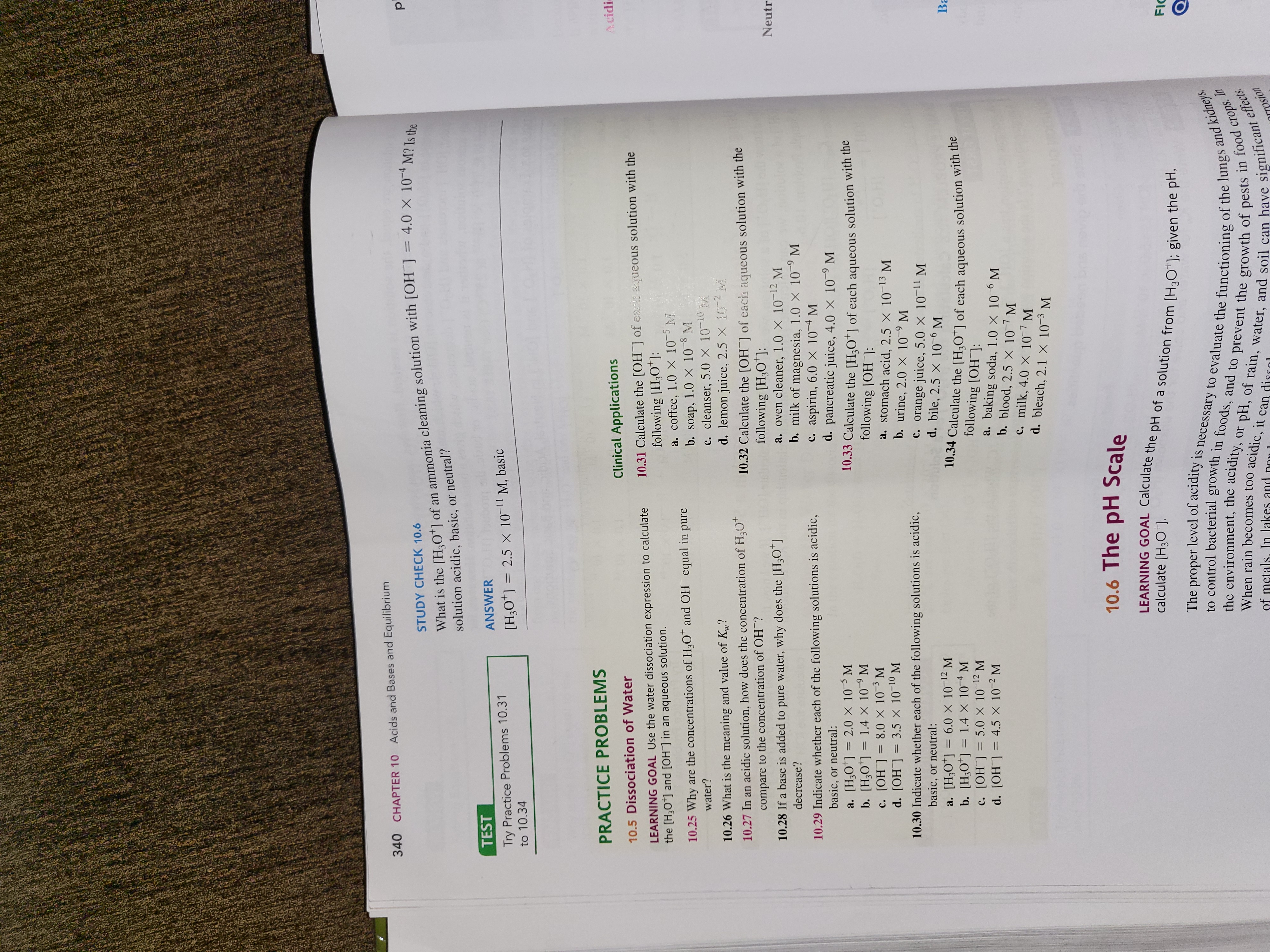
STUDY CHECK 10.6 What is the [H3O+] of an ammonia cleaning solution with [OH-] = 4.0 x 10^-4 M? Is the solution acidic, basic, or neutral? ANSWER [H3O+] = 2.5 x 10^-11 M, basic PRACTICE PROBLEMS 10.5 Dissociation of Water LEARNING GOAL Use the water dissociation expression to calculate the [H3O+] and [OH-] in an aqueous solution. 10.25 Why are the concentrations of H3O+ and OH- equal in pure water? 10.26 What is the meaning and value of Kw? 10.27 In an acidic solution, how does the concentration of H3O+ compare to the concentration of OH-? 10.28 If a base is added to pure water, why does the [H3O+] decrease? 10.29 Indicate whether each of the following solutions is acidic, basic, or neutral: a. [H3O+] = 2.0 x 10^-5 M b. [H3O+] = 1.4 x 10^-9 M c. [OH-] = 8.0 x 10^-3 M d. [OH-] = 3.5 x 10^-10 M 10.30 Indicate whether each of the following solutions is acidic, basic, or neutral: a. [H3O+] = 6.0 x 10^-12 M b. [H3O+] = 1.4 x 10^-4 M c. [OH-] = 5.0 x 10^-12 M d. [OH-] = 4.5 x 10^-2 M Clinical Applications 10.31 Calculate the [OH-] of each aqueous solution with the following [H3O+]: a. coffee, 1.0 x 10^-5 M b. soap, 1.0 x 10^-8 M c. cleanser, 5.0 x 10^-10 M d. lemon juice, 2.5 x 10^-2 M 10.32 Calculate the [OH-] of each aqueous solution with the following [H3O+]: a. oven cleaner, 1.0 x 10^-12 M b. milk of magnesia, 1.0 x 10^-9 M c. aspirin, 6.0 x 10^-4 M d. pancreatic juice, 4.0 x 10^-9 M 10.33 Calculate the [H3O+] of each aqueous solution with the following [OH-]: a. stomach acid, 2.5 x 10^-13 M b. urine, 2.0 x 10^-9 M c. orange juice, 5.0 x 10^-11 M d. bile, 2.5 x 10^-6 M 10.34 Calculate the [H3O+] of each aqueous solution with the following [OH-]: a. baking soda, 1.0 x 10^-6 M b. blood, 2.5 x 10^-7 M c. milk, 4.0 x 10^-7 M d. bleach, 2.1 x 10^-3 M 10.6 The pH Scale LEARNING GOAL Calculate the pH of a solution from [H3O+]; given the pH, calculate [H3O+]. The proper level of acidity is necessary to evaluate the functioning of the lungs and kidneys, to control bacterial growth in foods, and to prevent the growth of pests in food crops. In the environment, the acidity, or pH, of rain, water, and soil can have significant effects. When rain becomes too acidic, it can dissolve aluminum from soil, which is toxic to many plants and fish.
View Answer
divider
ANSWERED

Nicole Krahulik verified

Numerade educator

9.44 For each of the following solutions, calculate the: a. grams of 2.0% (m/m) NaCl solution that contains 7.50 g of NaCl b. milliliters of 25% (m/v) NaF solution that contains 4.0 g of NaF c. milliliters of 8.0% (v/v) ethanol solution that contains 20.0 mL of ethanol 9.45 Calculate the molarity of each of the following: a. 2.00 moles of glucose in 4.00 L of a glucose solution b. 4.00 g of KOH in 2.00 L of a KOH solution c. 5.85 g of NaCl in 400. mL of a NaCl solution 9.46 Calculate the molarity of each of the following: a. 0.500 mole of glucose in 0.200 L of a glucose solution b. 73.0 g of HCl in 2.00 L of a HCl solution c. 30.0 g of NaOH in 350. mL of a NaOH solution

View Answer
divider
ANSWERED

Ronald Prasad verified

Numerade educator

PRACTICE PROBLEMS 9.5 Dilution of Solutions LEARNING GOAL Describe the dilution of a solution; calculate the unknown concentration or volume when a solution is diluted. 9.55 Calculate the final concentration of each of the following: a. 2.0 L of a 6.0 M HCl solution is added to water so that the final volume is 6.0 L. b. Water is added to 0.50 L of a 12 M NaOH solution to make 3.0 L of a diluted NaOH solution. c. A 10.0-mL sample of a 25% (m/v) KOH solution is diluted with water so that the final volume is 100.0 mL. d. A 50.0-mL sample of a 15% (m/v) H2SO4 solution is added to water to give a final volume of 250 mL. 9.56 Calculate the final concentration of each of the following: a. 1.0 L of a 4.0 M HNO3 solution is added to water so that the final volume is 8.0 L. b. Water is added to 0.25 L of a 6.0 M NaF solution to make 2.0 L of a diluted NaF solution. c. A 50.0-mL sample of an 8.0% (m/v) KBr solution is diluted with water so that the final volume is 200.0 mL. d. A 5.0-mL sample of a 50.0% (m/v) acetic acid (HC2H3O2) solution is added to water to give a final volume of 25 mL. 9.57 Determine the final volume, in milliliters, of each of the following: a. a 1.5 M HCl solution prepared from 20.0 mL of a 6.0 M HCl solution

View Answer
divider
ANSWERED

Ronald Prasad verified

Numerade educator

9.47 Calculate the grams of solute needed to prepare each of the following: a. 2.00 L of a 1.50 M NaOH solution b. 4.00 L of a 0.200 M KCl solution c. 25.0 mL of a 6.00 M HCl solution 9.48 Calculate the grams of solute needed to prepare each of the following: a. 2.00 L of a 6.00 M NaOH solution b. 5.00 L of a 0.100 M CaCl2 solution c. 175 mL of a 3.00 M NaNO3 solution 9.49 For each of the following solutions, calculate the: a. liters of a 2.00 M KBr solution to obtain 3.00 moles of KBr b. liters of a 1.50 M NaCl solution to obtain 15.0 moles of NaCl c. milliliters of a 0.800 M Ca(NO3)2 solution to obtain 0.0500 mole of Ca(NO3)2 9.50 For each of the following solutions, calculate the: a. liters of a 4.00 M KCl solution to obtain 0.100 mole of KCl b. liters of a 6.00 M HCl solution to obtain 5.00 moles of HCl c. milliliters of a 2.50 M K2SO4 solution to obtain 1.20 moles of K2SO4 REVIEW Solving Equations (1.4) 9.5 Dilution of Solutions LEARNING GOAL Describe the dilution of a solution; calculate the new concentration or volume when a solution is diluted. In chemistry and biology, we often prepare a dilute solution from a more concentrated solution. In a process called dilution, a solvent, usually water, is added to a solution, which increases the volume. As a result, the concentration of the solution decreases. In your everyday life, you are making a dilution when you add three cans of water to a can of concentrated orange juice.

View Answer
divider
INSTANT ANSWER

# 9.63, 9.65, 9.69 properties of solutions

View Answer
divider
ANSWERED

Ronald Prasad verified

Numerade educator

9.44 For each of the following solutions, calculate the: a. grams of 2.0% (m/m) NaCl solution that contains 7.50 g of NaCl b. milliliters of 25% (m/v) NaF solution that contains 4.0 g of NaF c. milliliters of 8.0% (v/v) ethanol solution that contains 20.0 mL of ethanol 9.45 Calculate the molarity of each of the following: a. 2.00 moles of glucose in 4.00 L of a glucose solution b. 4.00 g of KOH in 2.00 L of a KOH solution c. 5.85 g of NaCl in 400. mL of a NaCl solution 9.46 Calculate the molarity of each of the following:

View Answer
divider
ANSWERED

Nicole Smina verified

Numerade educator

solvent water? Why does KCl form a solution with water, but nonpolar hexane (C6H14) does not form a solution with water? 2), oil, or grease, do not e particles of a nonpolar Try Practice Problems 9.3 to 9.6 Clinical Applications 9.5 Water is a polar solvent and carbon tetrachloride (CCl4) is a nonpolar solvent. In which solvent is each of the following, which is found or used in the body, more likely to be soluble? a. CaCO3 (calcium supplement), ionic b. retinol (vitamin A), nonpolar c. sucrose (table sugar), polar d. cholesterol (lipid), nonpolar 9.6 Water is a polar solvent and hexane (C6H14) is a nonpolar solvent. In which solvent is each of the following which is found or used in the body, more likely to be soluble? a. vegetable oil, nonpolar b. oleic acid (lipid), nonpolar

View Answer
divider