Problem 7.5
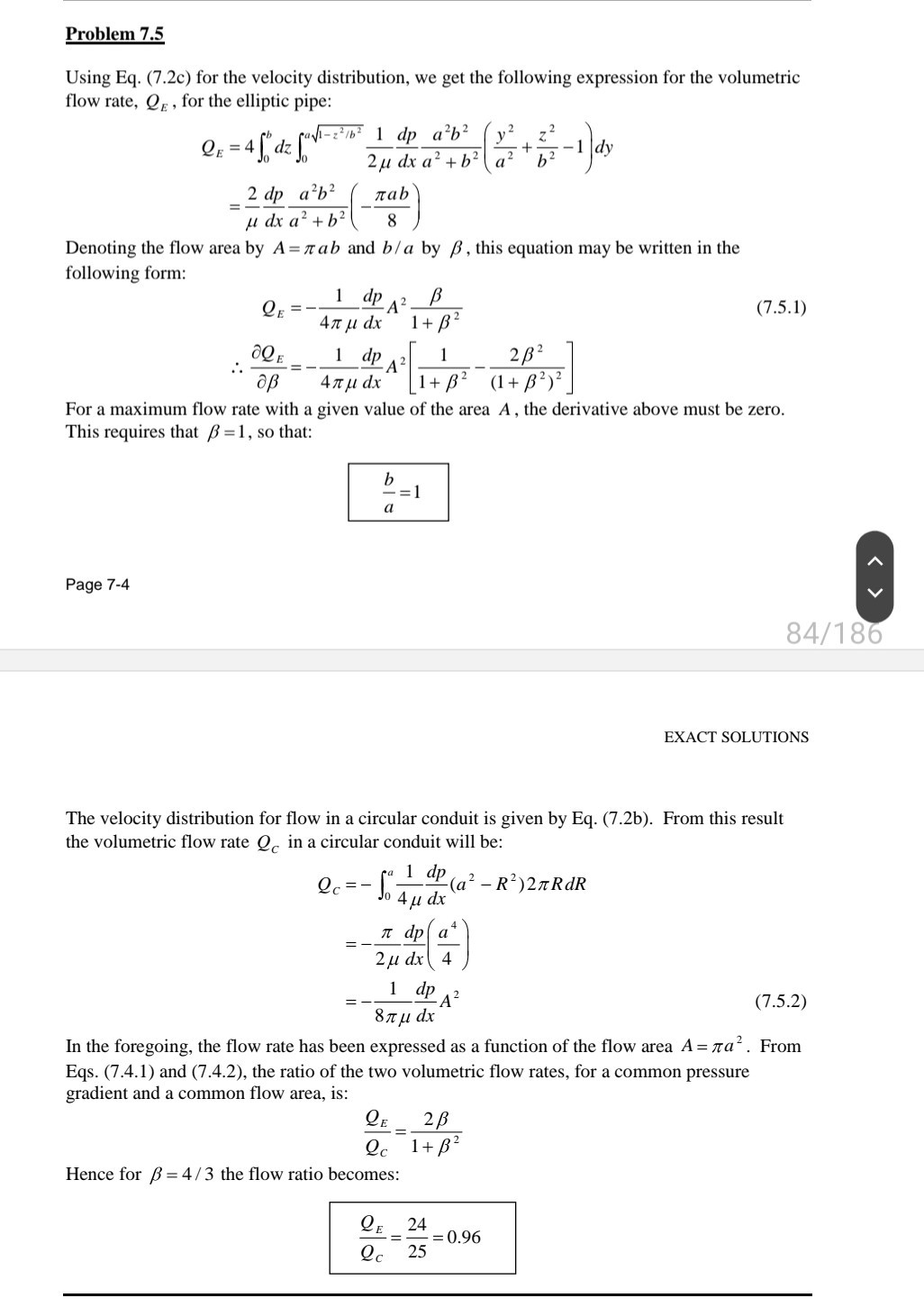
Using Eq. (7.2c) for the velocity distribution, we get the following expression for the volumetric flow rate, \( Q_{E} \), for the elliptic pipe:
\[
\begin{aligned}
Q_{E} & =4 \int_{0}^{b} d z \int_{0}^{a \sqrt{1-z^{2} / b^{2}}} \frac{1}{2 \mu} \frac{d p}{d x} \frac{a^{2} b^{2}}{a^{2}+b^{2}}\left(\frac{y^{2}}{a^{2}}+\frac{z^{2}}{b^{2}}-1\right) d y \\
& =\frac{2}{\mu} \frac{d p}{d x} \frac{a^{2} b^{2}}{a^{2}+b^{2}}\left(-\frac{\pi a b}{8}\right)
\end{aligned}
\]
Denoting the flow area by \( A=\pi a b \) and \( b / a \) by \( \beta \), this equation may be written in the following form:
\[
\begin{aligned}
Q_{E} & =-\frac{1}{4 \pi \mu} \frac{d p}{d x} A^{2} \frac{\beta}{1+\beta^{2}} \\
\therefore \frac{\partial Q_{E}}{\partial \beta} & =-\frac{1}{4 \pi \mu} \frac{d p}{d x} A^{2}\left[\frac{1}{1+\beta^{2}}-\frac{2 \beta^{2}}{\left(1+\beta^{2}\right)^{2}}\right]
\end{aligned}
\]
For a maximum flow rate with a given value of the area \( A \), the derivative above must be zero. This requires that \( \beta=1 \), so that:
\[
\frac{b}{a}=1
\]
Page 7-4
EXACT SOLUTIONS
The velocity distribution for flow in a circular conduit is given by Eq. (7.2b). From this result the volumetric flow rate \( Q_{C} \) in a circular conduit will be:
\[
\begin{aligned}
Q_{C} & =-\int_{0}^{a} \frac{1}{4 \mu} \frac{d p}{d x}\left(a^{2}-R^{2}\right) 2 \pi R d R \\
& =-\frac{\pi}{2 \mu} \frac{d p}{d x}\left(\frac{a^{4}}{4}\right) \\
& =-\frac{1}{8 \pi \mu} \frac{d p}{d x} A^{2}
\end{aligned}
\]
In the foregoing, the flow rate has been expressed as a function of the flow area \( A=\pi a^{2} \). From Eqs. (7.4.1) and (7.4.2), the ratio of the two volumetric flow rates, for a common pressure gradient and a common flow area, is:
\[
\frac{Q_{E}}{Q_{C}}=\frac{2 \beta}{1+\beta^{2}}
\]
Hence for \( \beta=4 / 3 \) the flow ratio becomes:
\[
\frac{Q_{E}}{Q_{C}}=\frac{24}{25}=0.96
\]