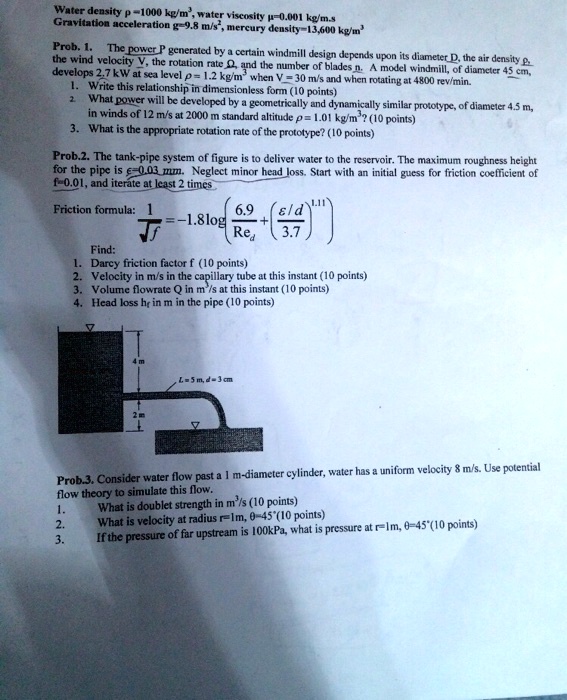
Please help me with question 2 step by step. I am so struggling. Thank you so much.
Water density p = 1000 kg/m^3, water viscosity = 0.001 kg/m.s, gravitational acceleration g = 9.8 m/s^2, mercury density = 13,600 kg/m^3
Prob. I. The power P generated by a certain windmill design depends upon its diameter D, the air density, the wind velocity V, the rotation rate, and the number of blades n. A model windmill, with a diameter of 45 cm, develops 2.7 kW at sea level when V = 30 m/s and when rotating at 4800 rev/min.
1. Write this relationship in dimensionless form. (10 points)
2. What power will be developed by a geometrically and dynamically similar prototype, with a diameter of 4.5 m, in winds of 12 m/s at 2000 m standard altitude p = 1.01 kg/m^3? (10 points)
3. What is the appropriate rotation rate of the prototype? (10 points)
Prob. 2. The tank-pipe system in the figure is designed to deliver water to the reservoir. The maximum roughness height for the pipe is e = 0.03 mm. Neglect minor head loss. Start with an initial guess for the friction coefficient of f = 0.01, and iterate at least 2 times. The friction formula is: 1/(6.9 * E/a - 1.81 * log Re)^3.7
Find:
1. Darcy friction factor f (10 points)
2. Velocity in m/s in the capillary tube at this instant (10 points)
3. Volume flowrate Q in m^3/s at this instant (10 points)
4. Head loss hr in m in the pipe (10 points)
Prob. 3. Consider water flow past a 1 m-diameter cylinder. The water has a uniform velocity of 8 m/s. Use potential flow theory to simulate this flow.
1. What is the doublet strength in m^3/s? (10 points)
2. What is the velocity at radius r = 1 m? (10 points)
If the pressure at the far upstream is 100 kPa, what is the pressure at r = 1 m? (10 points)