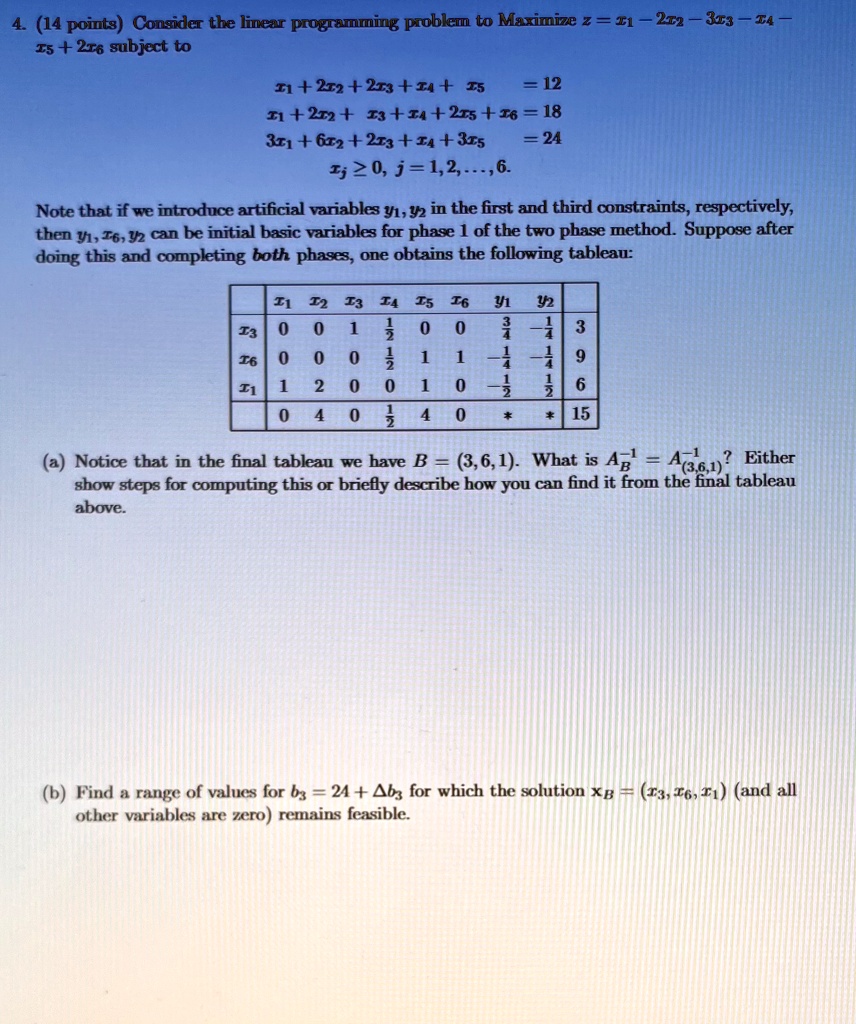
4. (14 points) Consider the linear programming problem to Maximize $z = x_1 - 2x_2 - 3x_3 - x_4 - x_5 + 2x_6$ subject to
$x_1 + 2x_2 + x_3 + x_4 + x_5 = 12$
$x_1 + 2x_2 + x_3 + x_4 + 2x_5 + x_6 = 18$
$3x_1 + 6x_2 + 2x_3 + x_4 + 3x_5 = 24$
$x_j \ge 0, j = 1, 2, \dots, 6.$
Note that if we introduce artificial variables $y_1, y_2$ in the first and third constraints, respectively, then $y_1, x_6, x_2$ can be initial basic variables for phase 1 of the two phase method. Suppose after doing this and completing both phases, one obtains the following tableau:
\begin{tabular}{|c|cccccc|cc|c|}
\hline
& $x_1$ & $x_2$ & $x_3$ & $x_4$ & $x_5$ & $x_6$ & $y_1$ & $y_2$ & \\
\hline
$x_3$ & 0 & 0 & 1 & 1 & 0 & 0 & $\frac{1}{4}$ & $\frac{-1}{4}$ & 3 \\
$x_6$ & 0 & 0 & 0 & 1 & 1 & 1 & $\frac{-1}{4}$ & $\frac{1}{4}$ & 9 \\
$x_2$ & 1 & 2 & 0 & 0 & 1 & 0 & $\frac{-1}{2}$ & $\frac{1}{2}$ & 6 \\
$x_1$ & 0 & 4 & 0 & 1 & 4 & 0 & * & * & 15 \\
\hline
\end{tabular}
(a) Notice that in the final tableau we have $B = (3, 6, 1)$. What is $A_B = A_{(3, 6, 1)}$? Either show steps for computing this or briefly describe how you can find it from the final tableau above.
(b) Find a range of values for $b_3 = 24 + \Delta b_3$ for which the solution $x_B = (x_3, x_6, x_1)$ (and all other variables are zero) remains feasible.