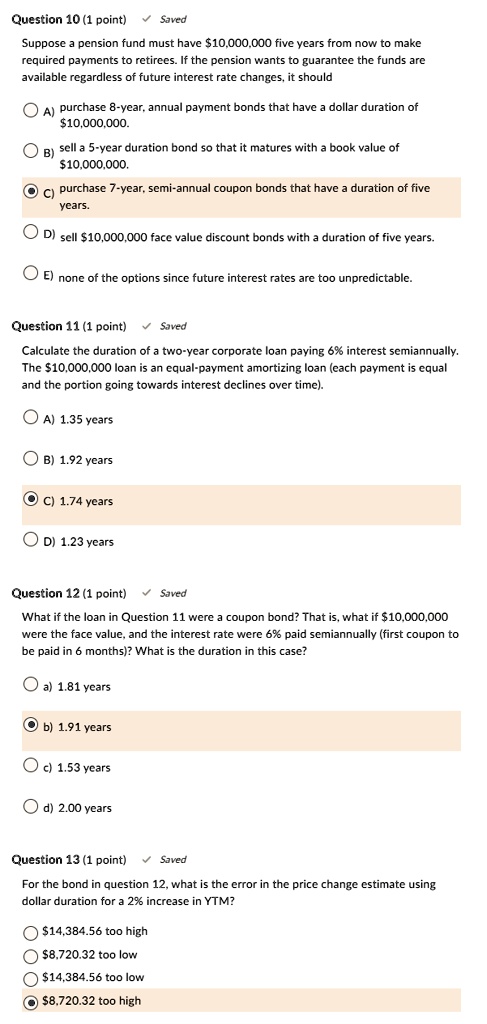
Question 10 (1 point)
Suppose a pension fund must have $10,000,000 five years from now to make
required payments to retirees. If the pension wants to guarantee the funds are
available regardless of future interest rate changes, it should
A) purchase 8-year, annual payment bonds that have a dollar duration of
$10,000,000.
B) sell a 5-year duration bond so that it matures with a book value of
$10,000,000.
C) purchase 7-year, semi-annual coupon bonds that have a duration of five
years.
D) sell $10,000,000 face value discount bonds with a duration of five years.
E) none of the options since future interest rates are too unpredictable.
Question 11 (1 point)
Calculate the duration of a two-year corporate loan paying 6% interest semiannually.
The $10,000,000 loan is an equal-payment amortizing loan (each payment is equal
and the portion going towards interest declines over time).
A) 1.35 years
B) 1.92 years
C) 1.74 years
D) 1.23 years
Question 12 (1 point)
What if the loan in Question 11 were a coupon bond? That is, what if $10,000,000
were the face value, and the interest rate were 6% paid semiannually (first coupon to
be paid in 6 months)? What is the duration in this case?
a) 1.81 years
b) 1.91 years
c) 1.53 years
d) 2.00 years
Question 13 (1 point)
For the bond in question 12, what is the error in the price change estimate using
dollar duration for a 2% increase in YTM?
$14,384.56 too high
$8,720.32 too low
$14,384.56 too low
$8,720.32 too high