gopoly and Game Theory
Suppose that PepsiCo and Coca-Cola each are determining whether to spend money on an ad campaign to air
during the Super Bowl. The possible choices and outcomes are these:
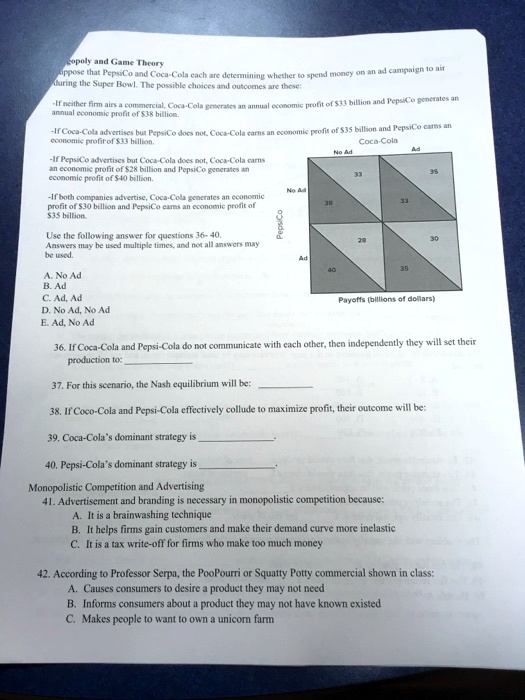
-If neither firm airs a commercial, Coca-Cola generates an annual economic profit of $33 billion and PepsiCo generates an
annual economic profit of $38 billion.
-If Coca-Cola advertises but PepsiCo does not, Coca-Cola earns an economic profit of $35 billion and PepsiCo earns an
economic profit of $33 billion.
-If PepsiCo advertises but Coca-Cola does not, Coca-Cola earns
an economic profit of $28 billion and PepsiCo generates an
economic profit of $40 billion.
-If both companies advertise, Coca-Cola generates an economic
profit of $30 billion and PepsiCo earns an economic profit of
$35 billion.
Use the following answer for questions 36-40.
Answers may be used multiple times, and not all answers may
be used.
A. No Ad
B. Ad
C. Ad, Ad
D. No Ad, No Ad
E. Ad, No Ad
36. If Coca-Cola and Pepsi-Cola do not communicate with each other, then independently they will set their
production to:
37. For this scenario, the Nash equilibrium will be:
38. If Coco-Cola and Pepsi-Cola effectively collude to maximize profit, their outcome will be:
39. Coca-Cola's dominant strategy is
40. Pepsi-Cola's dominant strategy is
Monopolistic Competition and Advertising
41. Advertisement and branding is necessary in monopolistic competition because:
A. It is a brainwashing technique
B. It helps firms gain customers and make their demand curve more inelastic
C. It is a tax write-off for firms who make too much money
42. According to Professor Serpa, the PooPourri or Squatty Potty commercial shown in class:
A. Causes consumers to desire a product they may not need
B. Informs consumers about a product they may not have known existed
C. Makes people to want to own a unicorn farm