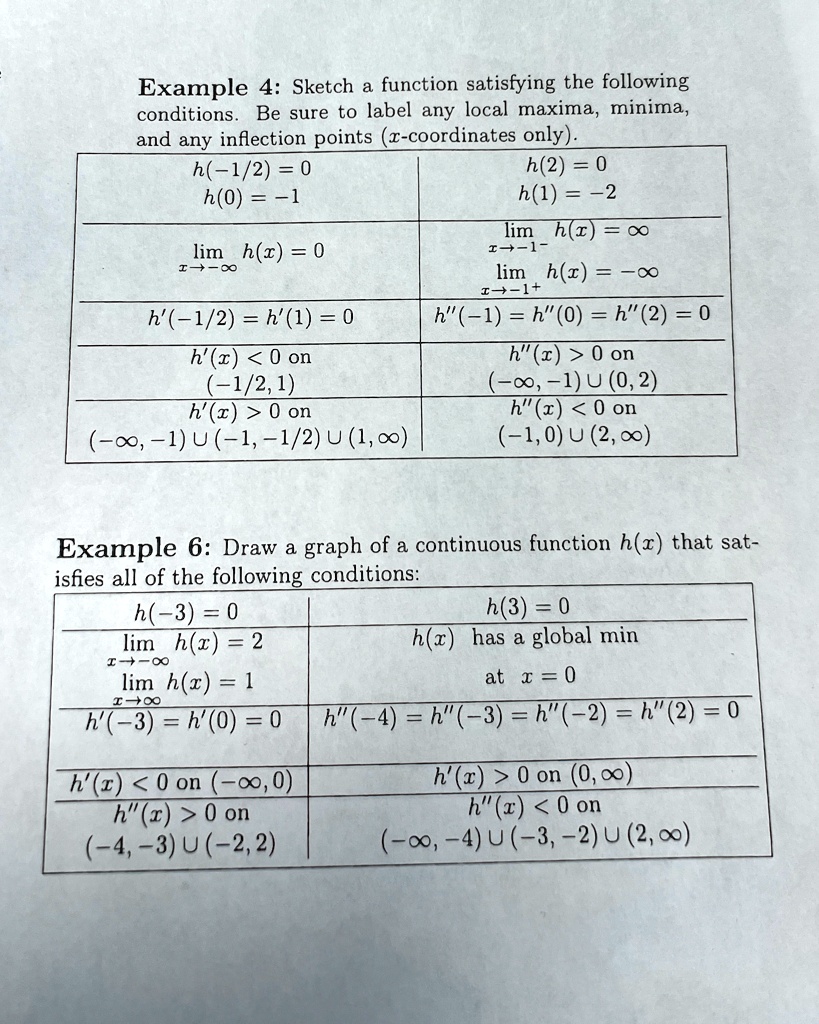
Example 4: Sketch a function satisfying the following
conditions. Be sure to label any local maxima, minima,
and any inflection points (x-coordinates only).
$$h(-1/2) = 0$$
$$h(0) = -1$$
$$\lim_{x\to -\infty} h(x) = 0$$
$$h'(-1/2) = h'(1) = 0$$
$$h'(x) < 0 \text{ on } (-1/2,1)$$
$$h'(x) > 0 \text{ on } (-\infty,-1) \cup (-1,-1/2) \cup (1,\infty)$$
$$h(2) = 0$$
$$h(1) = -2$$
$$\lim_{x\to -1^-} h(x) = \infty$$
$$\lim_{x\to -1^+} h(x) = -\infty$$
$$h''(-1) = h''(0) = h''(2) = 0$$
$$h''(x) > 0 \text{ on } (-\infty,-1) \cup (0, 2)$$
$$h''(x) < 0 \text{ on } (-1,0) \cup (2,\infty)$$
Example 6: Draw a graph of a continuous function h(x) that sat-
isfies all of the following conditions:
$$h(-3) = 0$$
$$\lim_{x\to -\infty} h(x) = 2$$
$$\lim_{x\to \infty} h(x) = 1$$
$$h(3) = 0$$
$$h(x) \text{ has a global min at } x = 0$$
$$h'(-3) = h'(0) = 0$$
$$h''(-4) = h''(-3) = h''(-2) = h''(2) = 0$$
$$h'(x) < 0 \text{ on } (-\infty,0)$$
$$h''(x) > 0 \text{ on } (-4, -3) \cup (-2,2)$$
$$h'(x) > 0 \text{ on } (0,\infty)$$
$$h''(x) < 0 \text{ on } (-\infty,-4) \cup (-3,-2) \cup (2,\infty)$$