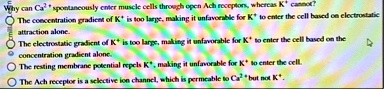
Why can $Ca^{2+}$ spontaneously enter muscle cells through open Ach receptors, whereas $K^+$ cannot?
The concentration gradient of $K^+$ is too large, making it unfavorable for $K^+$ to enter the cell based on electrostatic attraction alone.
The electrostatic gradient of $K^+$ is too large, making it unfavorable for $K^+$ to enter the cell based on the concentration gradient alone.
The resting membrane potential repels $K^+$, making it unfavorable for $K^+$ to enter the cell.
The Ach receptor is a selective ion channel, which is permeable to $Ca^{2+}$ but not $K^+$.