Ace - AI Tutor
Ask Our Educators
Textbooks
My Library
Flashcards
Scribe - AI Notes
Notes & Exams
Download App
gloria weaver

gloria w.

Divider

Questions asked

BEST MATCH

how do you factor? $(x - \ln x)$ and why does it become x on denominator? $x(1 - \frac{\ln x}{x})$

View Answer
divider
BEST MATCH

Cost advantages that occur only at the firm level are defined as Select one: a. diseconomies of scale b. product differentiation c. external economies of scale d. internal economies of scale

View Answer
divider
BEST MATCH

Identify the true and false statements about statistical validity of frequency claims

View Answer
divider
BEST MATCH

A 10 minute presentation presented in groups of 3-4, randomly assigned in class. There will be a five minute question period following each group’s presentation. Develop a novel study which investigates some component of human development and integrates your interests. The presentation should include: 1

View Answer
divider
BEST MATCH

What are two types of loan endorsers? borrowers and lenders guarantors and comakers investors and guarantors comakers and investors

View Answer
divider
BEST MATCH

Question 50 An antigen that you might see on a virus would be a O chitin. O cilia. O fimbriae. O capsid.

View Answer
divider
BEST MATCH

Market capitalization is defined as the Blank______. Multiple choice question. value added by each dollar the shareholder has invested difference between the market value of the firm's shares and the amount of money shareholders has invested total market value of the firm's equity tracking of financial leverage

View Answer
divider
BEST MATCH

RockCorp. has a target capital structure of 60 per cent common equity, 25 per cent debt, and the rest in the form of preferred stock. Its cost of equity is 14 per cent, the firm's cost of preferred stock is 12 per cent, and its cost of debt is eight per cent. The relevant tax rate is 20 per cent. What is the firm's WACC?

View Answer
divider
BEST MATCH

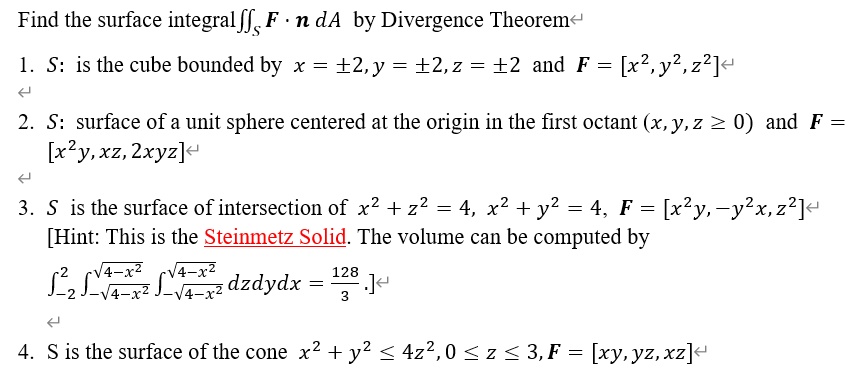
Find the surface integral ∬_(S)F*ndA by Divergence Theorem S: is the cube bounded by x=±2, y=±2, z=±2 and F=[x^(2), y^(2), z^(2)] S: surface of a unit sphere centered at the origin in the first octant (x, y, z ≥ 0) and F= x^(2)y, xz, 2xyz S is the surface of intersection of x^(2) + z^(2) = 4, x^(2) + y^(2) = 4, F=[x^(2)y, -y^(2)x, z^(2)] [Hint: This is the Steinmetz Solid. The volume can be computed by ∫_(-2)^2 ∫_(-√(4-x^(2)))^(√(4-x^(2))) ∫_(-√(4-x^(2)))^(√(4-x^(2))) dzdydx = 128/3.] S is the surface of the cone x^(2) + y^(2) ≤ 4z^(2), 0 ≤ z ≤ 3, F=[xy, yz, xz] Find the surface integral ∬F · ndA by Divergence Theorem 1. S: is the cube bounded by x=2, y=2, z=2 and F=[x^(2), y^(2), z^(2)] 2. S: surface of a unit sphere centered at the origin in the first octant (x, y, z ≥ 0) and F=[x^(2)y, xz, 2xyz] 3. S is the surface of intersection of x^(2) + z^(2) = 4, x^(2) + y^(2) = 4, F=[x^(2)y, -y^(2)x, z^(2)] [Hint: This is the Steinmetz Solid. The volume can be computed by 4. S is the surface of the cone x^(2) + y^(2) ≤ 4z^(2), 0 ≤ z ≤ 3, F=[xy, yz, xz]
View Answer
divider
BEST MATCH

Esta es una tabla que muestra las 52 cartas en una baraja estándar. \begin{tabular}{|c|c|c|c|c|c|c|c|c|c|c|c|c|c|c|} \hline \multirow[b]{2}{*}{ Color } & \multirow[b]{2}{*}{ Palo } & \multirow[b]{2}{*}{ As } & \multirow[b]{2}{*}{ Dos } & \multirow[b]{2}{*}{ Tres } & \multirow[b]{2}{*}{ Cuatro } & \multirow[b]{2}{*}{ Cinco } & \multirow[b]{2}{*}{ Seis } & \multirow[b]{2}{*}{ Siete } & \multirow[b]{2}{*}{ Ocho } & \multirow[b]{2}{*}{ Nueve } & \multirow[b]{2}{*}{ Diez } & \multicolumn{3}{|c|}{ Figuras } \\ \hline & & & & & & & & & & & & Jota & Reina & Rey \\ \hline Rojo & Corazones & \( A \bullet \) & 20 & \( 3 \bullet \) & \( 4 \% \) & 50 & \( 6 \bullet \) & \( 7 \bullet \) & \( 8 \bullet \) & 90 & \( 10 \% \) & \( J \bullet \) & \( Q^{\bullet} \) & \( K^{\bullet} \) \\ \hline Rojo & Diamantes & \( A \diamond \) & \( 2 \diamond \) & \( 3 \diamond \) & \( 4 \diamond \) & \( 5 \diamond \) & \( {6} \cdot \) & \( 7 \diamond \) & \( {8} \cdot \) & \( 9 \diamond \) & \( 10 \diamond \) & \( J \bullet \) & \( Q^{\bullet} \) & \( K \bullet \) \\ \hline Negro & Picas & \( A \boldsymbol{Q} \) & \( 2 \varphi \) & 39 & 49 & 59 & 69 & 79 & 89 & 99 & 109 & \( J \varphi \) & \( Q \) & \( K \varphi \) \\ \hline Negro & Tréboles & & 24 & 34 & 49 & 59 & 64 & 74 & 89 & 94 & \( 10 \% \) & \( J \$ \) & \( Q \) & \\ \hline \end{tabular} Supongamos que se saca una carta al azar de una baraja. La carta se mezcla de nuevo en la baraja. Luego, por segunda vez, se saca una carta al azar de la baraja. La carta se mezcla de nuevo en la baraja. Por tercera y última vez, se saca una carta al azar de la baraja. ¿Cuál es la probabilidad de que primero salga una carta roja, luego salga una pica y luego salga una figura? Redondear la respuesta final a cuatro posiciones decimales, sin redondear los cálculos intermedios. (De ser necesario, puede consultar una lista de fórmulas).

View Answer
divider