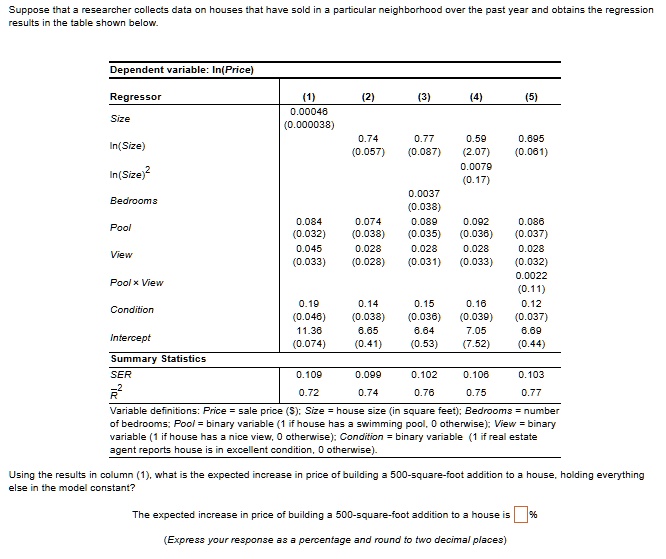
Suppose that a researcher collects data on houses that have sold in a particular neighborhood over the past year and obtains the regression results in the table shown below.
Dependent variable: In(Price)
Regressor
Size
(1)
0.00046
(0.000038)
(2)
(3)
(4)
(5)
0.74
In(Size)
(0.057)
0.77
(0.087)
0.59
0.695
(2.07) (0.061)
In (Size)$^2$
0.0079
(0.17)
0.0037
Bedrooms
(0.038)
0.084
0.074
0.089 0.092
0.086
Pool
View
(0.032) (0.038)
(0.035) (0.036)
(0.037)
0.045
0.028
0.028
0.028
0.028
(0.033)
(0.028)
(0.031)
(0.033)
(0.032)
0.0022
Pool x View
(0.11)
Condition
0.19
(0.046)
0.14
0.15
0.16
0.12
(0.038)
(0.036) (0.039)
(0.037)
11.36
6.65
6.64
7.05
6.69
Intercept
(0.074)
(0.41)
(0.53)
(7.52)
(0.44)
Summary Statistics
SER
0.109
0.099
0.102
0.106
0.103
$R^2$
0.72
0.74
0.76
0.75
0.77
Variable definitions: Price = sale price ($); Size = house size (in square feet); Bedrooms = number
of bedrooms: Pool = binary variable (1 if house has a swimming pool, O otherwise); View = binary
variable (1 if house has a nice view, O otherwise); Condition = binary variable (1 if real estate
agent reports house is in excellent condition, O otherwise).
Using the results in column (1), what is the expected increase in price of building a 500-square-foot addition to a house, holding everything
else in the model constant?
The expected increase in price of building a 500-square-foot addition to a house is %
(Express your response as a percentage and round to two decimal places)