Example: A home thermostat
Accuracy is measured by |T_(actual )-T_(set )|
The factory calibrates the thermostat by adjusting it to 70F in a 70F chamber
The sales price at the Home Depot is $23.41.
The customer desires accuracy
100% of the customers will ask for a refund if they set the thermostat at 70F and the actual temperature is 65F or 75F
The manufacturer set a warranty cost goal of 1% of the sales prices
Using the loss function concept, what tolerance should the factory use during calibration?
15
Example: solution
The factory pays a dis-satisfied customers the full purchase price ($23.41)
The customer will return the thermostat when it is "off" by 5^(0)F
The factory will be use the Taguchi loss function to set a calibration limit.
The loss function, assessed by the performance at 70deg F, is given by
L(T)=K(T-70)^(2)
, Therefore, K=(23.41)/(5^(2)).
A calibration limit is determined using the equation EL^(**)=K(sigma ^(2)+D^(2))
Assuming no variability (sigma ^(2)) during calibration, the expected loss is bounded by KD^(2), where D is max(T_(cal. )-T_(actual )) throughout the production process.
The factory wishes to limit their average warranty costs to 1% of the sales price ($0.2341), so the tolerance limit D is given by (23.41)/(100)=KD^(2).
Recall that K=(23.41)/(5^(2)), so then D=sqrt((25)/(100))=0.5F^(o)
Finally, were one to consider variability, D would have to be reduced to maintain the company's warranty-cost goal.
Expected Loss
Voluntary assignment 4_due 2/28 at 11:59 PM
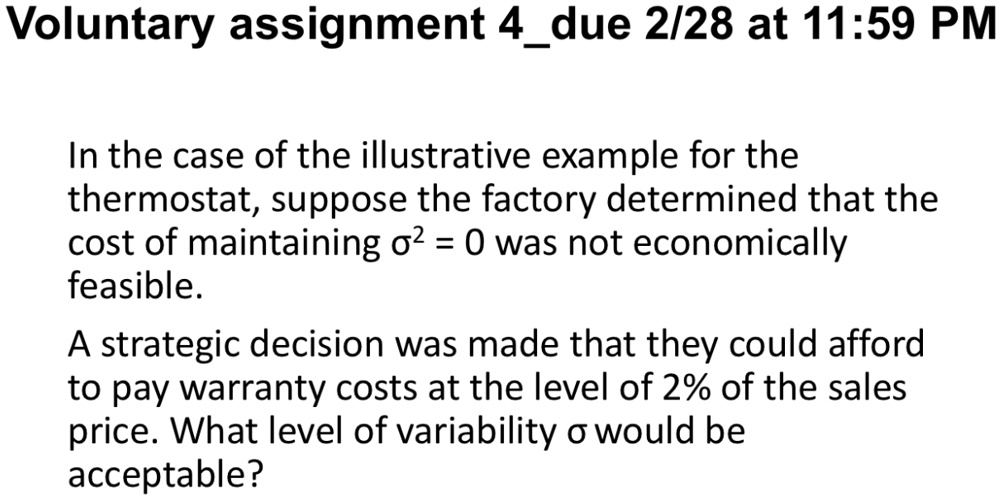
In the case of the illustrative example for the thermostat, suppose the factory determined that the cost of maintaining sigma ^(2)=0 was not economically feasible.
A strategic decision was made that they could afford to pay warranty costs at the level of 2% of the sales price. What level of variability sigma would be acceptable?
Voluntary assignment 4_due 2/28 at 11:59 PM
In the case of the illustrative example for the thermostat, suppose the factory determined that the cost of maintaining o2 = 0 was not economically feasible.
A strategic decision was made that they could afford to pay warranty costs at the level of 2% of the sales price. What level of variability o would be acceptable?