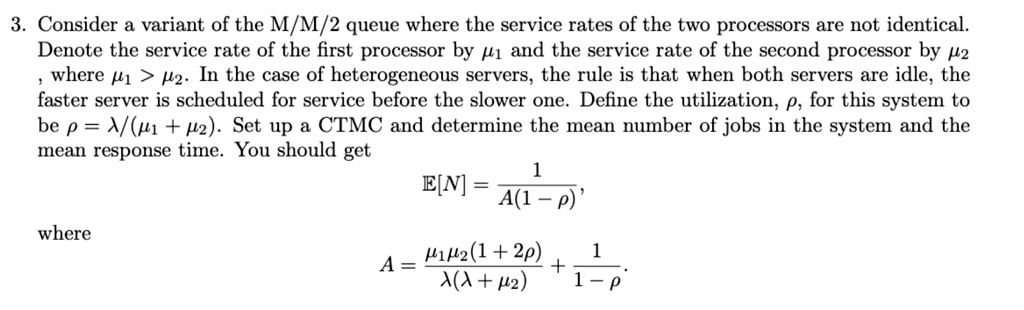
3. Consider a variant of the M/M/2 queue where the service rates of the two processors are not identical.
Denote the service rate of the first processor by $\mu_1$ and the service rate of the second processor by $\mu_2$
, where $\mu_1 > \mu_2$. In the case of heterogeneous servers, the rule is that when both servers are idle, the
faster server is scheduled for service before the slower one. Define the utilization, $\rho$, for this system to
be $\rho = \lambda/(\mu_1 + \mu_2)$. Set up a CTMC and determine the mean number of jobs in the system and the
mean response time. You should get
$$E[N] = \frac{1}{A(1 - \rho)},$$
where
$$A = \frac{\mu_1\mu_2(1 + 2\rho)}{\lambda(\lambda + \mu_2)} + \frac{1}{1 - \rho}.$$