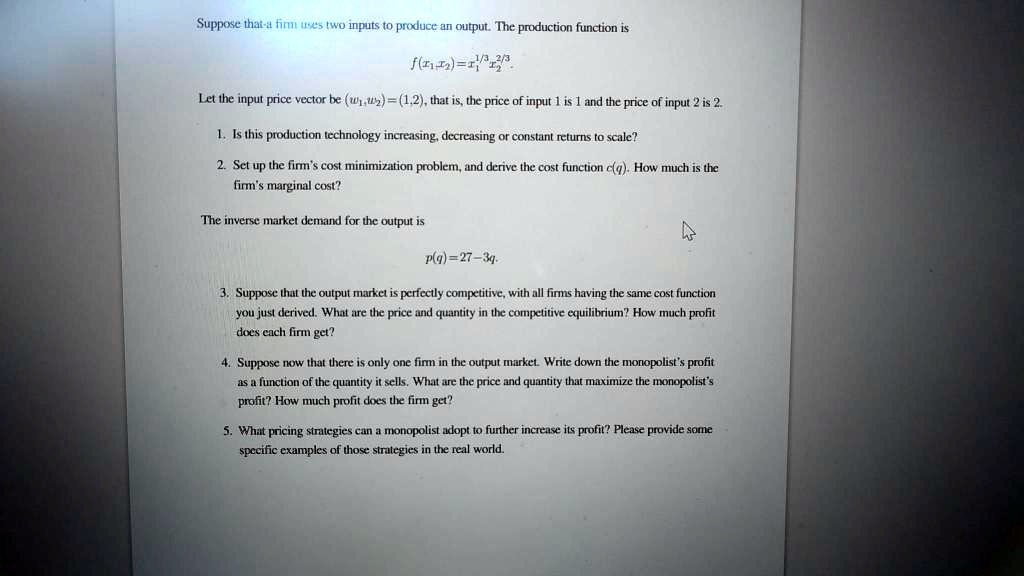
Suppose that a firm uses two inputs to produce an output. The production function is
$f(x_1, x_2) = x_1^{1/3} x_2^{2/3}$.
Let the input price vector be $(w_1, w_2) = (1, 2)$, that is, the price of input 1 is 1 and the price of input 2 is 2.
1. Is this production technology increasing, decreasing or constant returns to scale?
2. Set up the firm's cost minimization problem, and derive the cost function $c(q)$. How much is the
firm's marginal cost?
The inverse market demand for the output is
$p(q) = 27 - 3q$.
3. Suppose that the output market is perfectly competitive, with all firms having the same cost function
you just derived. What are the price and quantity in the competitive equilibrium? How much profit
does each firm get?
4. Suppose now that there is only one firm in the output market. Write down the monopolist's profit
as a function of the quantity it sells. What are the price and quantity that maximize the monopolist's
profit? How much profit does the firm get?
5. What pricing strategies can a monopolist adopt to further increase its profit? Please provide some
specific examples of those strategies in the real world.