Ace - AI Tutor
Ask Our Educators
Textbooks
My Library
Flashcards
Scribe - AI Notes
Notes & Exams
Download App
gregory cobb

gregory c.

Divider

Questions asked

BEST MATCH

The frequency spectrum of a continuous-time periodic signal f(t) is continuous. True or False

View Answer
divider
BEST MATCH

energy of each level in units of (h^(2))/(8mV^((2)/(3))) energy of each level in units of $h^2/8mV^{2/3}$

View Answer
divider
BEST MATCH

What can be applied to developing teeth to allow them to be strong and decay resistant?

View Answer
divider
BEST MATCH

what is a bacterial infection caused by water or food that has been contaminated by human feces?

View Answer
divider
BEST MATCH

What roles might a public health nurse assume following report of a communicable disease outbreak?

View Answer
divider
BEST MATCH

NCLEX Prep - Test Bank Question: Please read the clinical scenario, and then answer the questions that follow to become familiar with the traditional NCLEX question format. A 59-year-old female has been diagnosed with Escherichia coli infection following the consumption of contaminated meat. The patient is exhibiting a high fever, severe abdominal cramping, and diarrhea. The RN provides supportive care and fluid resuscitation as ordered. The nurse and medical team provide education to the patient and her family regarding the genetics of the E. coli bacterium. In gram-negative bacteria, like E. coli, the fertility factor is a plasmid possessed by the bacterium that will donate its DNA to a recipient cell. Which of the following statements by the patient demonstrates an understanding of this plasmid? (A) It is a large, double-stranded linear piece of DNA. B) It is found in F- cells only. C It controls the process of transduction in bacterial cells. (D) It encodes the information to create a pilus.

View Answer
divider
BEST MATCH

What is the similarity between a virus and a eukaryotic cell?

View Answer
divider
BEST MATCH

Find the length of the parametric curve $c(t) = (\cos 2t, \sin 2t)$ over the interval $0 \le t \le \frac{\pi}{2}$.

View Answer
divider
BEST MATCH

4.3 Derive the inverse kinematics of the three-link manipulator of Fig. 3.29. It means to find out the set of joint angles ($\theta_1, \theta_2, \theta_3$) for given the desired position ($x^d, y^d, z^d$) at the tip of the end effect. Notice that the desired position is given at the tip not the write of the manipulator and assume that the link 3 length is $L_3$. FIGURE 3.29: The 3R nonplanar arm (Exercise 3.3).

View Answer
divider
BEST MATCH

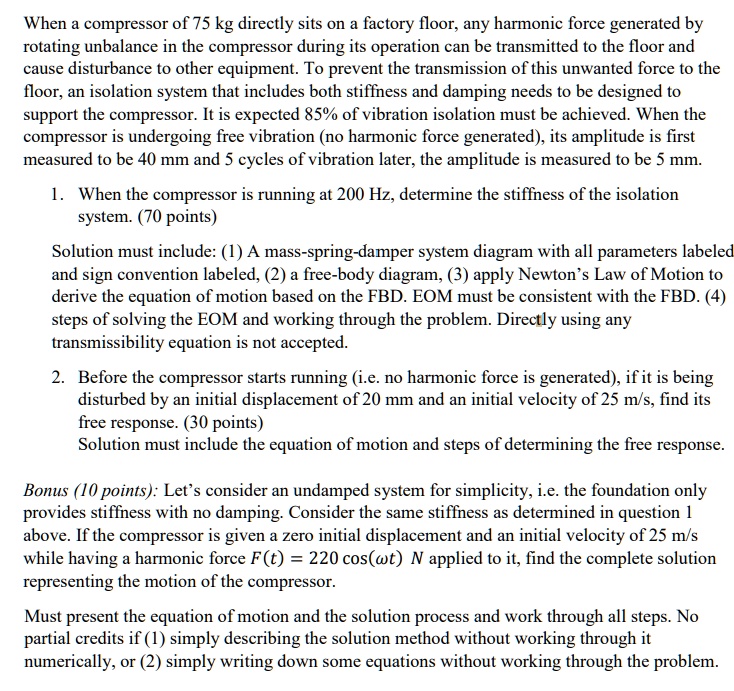
When a compressor of 75 kg directly sits on a factory floor, any harmonic force generated by rotating unbalance in the compressor during its operation can be transmitted to the floor and cause disturbance to other equipment. To prevent the transmission of this unwanted force to the floor, an isolation system that includes both stiffness and damping needs to be designed to support the compressor. It is expected that 85% of vibration isolation must be achieved. When the compressor is undergoing free vibration (no harmonic force generated), its amplitude is first measured to be 40 mm and 5 cycles of vibration later, the amplitude is measured to be 5 mm. 1. When the compressor is running at 200 Hz, determine the stiffness of the isolation system. (70 points) Solution must include: (1) A mass-spring-damper system diagram with all parameters labeled and sign convention labeled, (2) a free-body diagram, (3) apply Newton's Law of Motion to derive the equation of motion based on the FBD. EOM must be consistent with the FBD. (4) steps of solving the EOM and working through the problem. Directly using any transmissibility equation is not accepted. 2. Before the compressor starts running (i.e. no harmonic force is generated), if it is being disturbed by an initial displacement of 20 mm and an initial velocity of 25 m/s, find its free response. (30 points) Solution must include the equation of motion and steps of determining the free response. Bonus (10 points): Let's consider an undamped system for simplicity, i.e. the foundation only provides stiffness with no damping. Consider the same stiffness as determined in question 1 above. If the compressor is given a zero initial displacement and an initial velocity of 25 m/s while having a harmonic force F(t) = 220 cos(t) N applied to it, find the complete solution representing the motion of the compressor. Must present the equation of motion and the solution process and work through all steps. No partial credits if (1) simply describing the solution method without working through it numerically, or (2) simply writing down some equations without working through the problem.
View Answer
divider