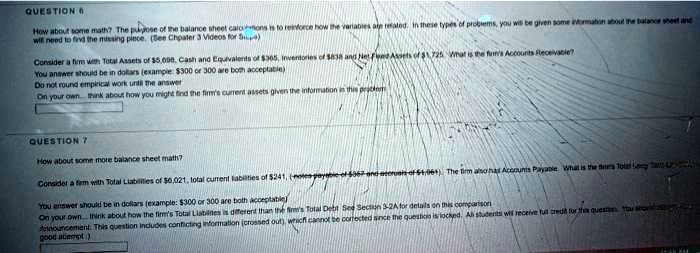
QUESTION 6
How about some math? The purpose of the balance sheet calculations is to reinforce how the variables are related. In these types of problems, you will be given some information about the balance sheet and
will need to find the missing piece. (See Chapter 3 Videos for help.)
Consider a firm with Total Assets of $5,066, Cash and Equivalents of $365, Inventories of $838 and Net Fixed Assets of $1,725. What is the firm's Accounts Receivable?
You answer should be in dollars (example: $300 or 300 are both acceptable)
Do not round empirical work until the answer.
On your own, think about how you might find the firm's current assets given the information in this problem.
QUESTION 7
How about some more balance sheet math?
Consider a firm with Total Liabilities of $6,021, total current liabilities of $241, (notes payable of $367 and accounts of $4166). The firm also has Accounts Payable. What is the firm's Total Long Term Liabilities?
You answer should be in dollars (example: $300 or 300 are both acceptable)
On your own, think about how the firm's Total Liabilities is different than the firm's Total Debt. See Section 3-2A for details on this comparison.
Announcement: This question includes conflicting information (crossed out), which cannot be corrected since the question is locked. All students will receive full credit for this question. You should still give it a good attempt :-)